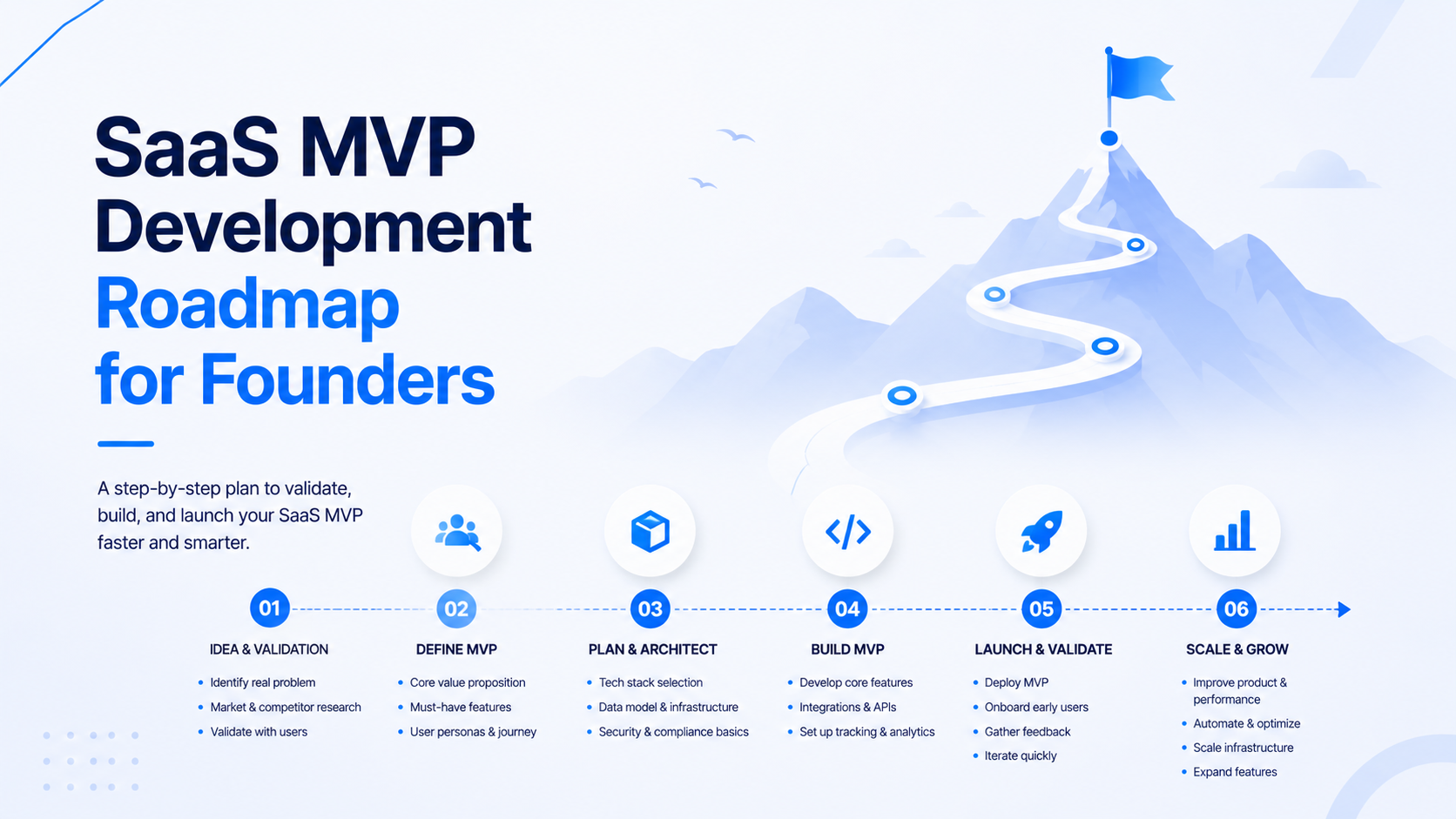
Building a SaaS MVP is one of the most technically and strategically challenging things a founder can undertake. Unlike a simple website or a one-time project, a SaaS application must handle user authentication, subscription billing, multi-tenant data isolation, and a reliable deployment pipeline—all on day one. Making the wrong architectural decisions in the first sprint can haunt you for years.
This roadmap breaks the SaaS MVP journey into clear, actionable phases that you can follow regardless of your technical background.
Phase 1: Discovery (Week 1-2)
Before writing a single line of code, you must answer three fundamental questions:
- What is the core value exchange? The one, single action that makes a user's day better. Everything else is a "nice to have."
- Who is the paying customer? Is this B2B (companies) or B2C (individuals)? This determines your data model, billing structure, and security requirements entirely.
- What does "done" look like for the MVP? Write down the exact 3-5 user journeys that the MVP must support. If a feature is not on this list, it is not in scope.
At the end of this phase, you should have a simple product brief and basic wireframes. No code yet.
Phase 2: Stack Selection and Project Setup (Week 2-3)
Choose the technology stack based on pragmatic criteria: developer talent pool, time-to-market, and the product's core technical requirements.
- For a B2B SaaS with complex workflows: Laravel (PHP) backend with a React or Livewire frontend. Laravel's built-in auth, queues, and Cashier billing will get you to market in weeks, not months.
- For a real-time, dashboard-heavy SaaS: MERN stack (Node.js/Express backend + React frontend), utilizing WebSockets and TanStack Query on the frontend.
- Database: Default to PostgreSQL or MySQL for B2B SaaS. The relational model enforces data integrity that is critical when money is involved. Only consider MongoDB if your data is fundamentally document-oriented (like a CMS).
Phase 3: Database Schema Design (Week 3)
This is the most critical phase. The database schema is the foundation of the entire product.
- Core Tables/Collections: Users, Organizations (for multi-tenancy), Subscriptions/Plans, and the domain-specific tables (e.g., Projects, Invoices, Reports).
- Multi-Tenancy Pattern: Every single row in the database that belongs to an organization must have an
organization_idforeign key. Never skip this for the MVP, thinking "we'll add it later." You will not. Adding it later requires a database migration across millions of rows. - Write the Migrations First: In Laravel, write all database migration files before building any API endpoints. This forces clarity on the data model before business logic is layered on top.
Phase 4: Core Feature Build (Week 4-10)
Now you build. Follow a strict weekly sprint cadence.
- Sprint 1: Authentication (sign up, login, password reset, email verification) and the organization/tenant structure.
- Sprint 2: Subscription billing integration (Stripe Checkout for the MVP — do not build custom billing).
- Sprint 3-6: The 3-5 core user journeys, one per sprint.
- Ground Rule: No new features are added to the current sprint scope. New ideas go into the backlog. Focus is everything.
Phase 5: Deployment and Launch (Week 10-12)
- Hosting: DigitalOcean App Platform, Railway, or a managed VPS via Laravel Forge. Avoid setting up your own raw AWS infrastructure for the MVP.
- CI/CD: GitHub Actions to run tests automatically and deploy to staging on every PR merge.
- Monitoring: Integrate Sentry for error tracking before you launch. You must know about crashes before your users do.
If you need an experienced partner to guide you through this entire roadmap and build your SaaS MVP with you, visit my hire full-stack developer India page to discuss your project.

Prakash Tank
Full-Stack Architect & Tech Enthusiast. Passionate about building scalable applications and sharing knowledge with the community.