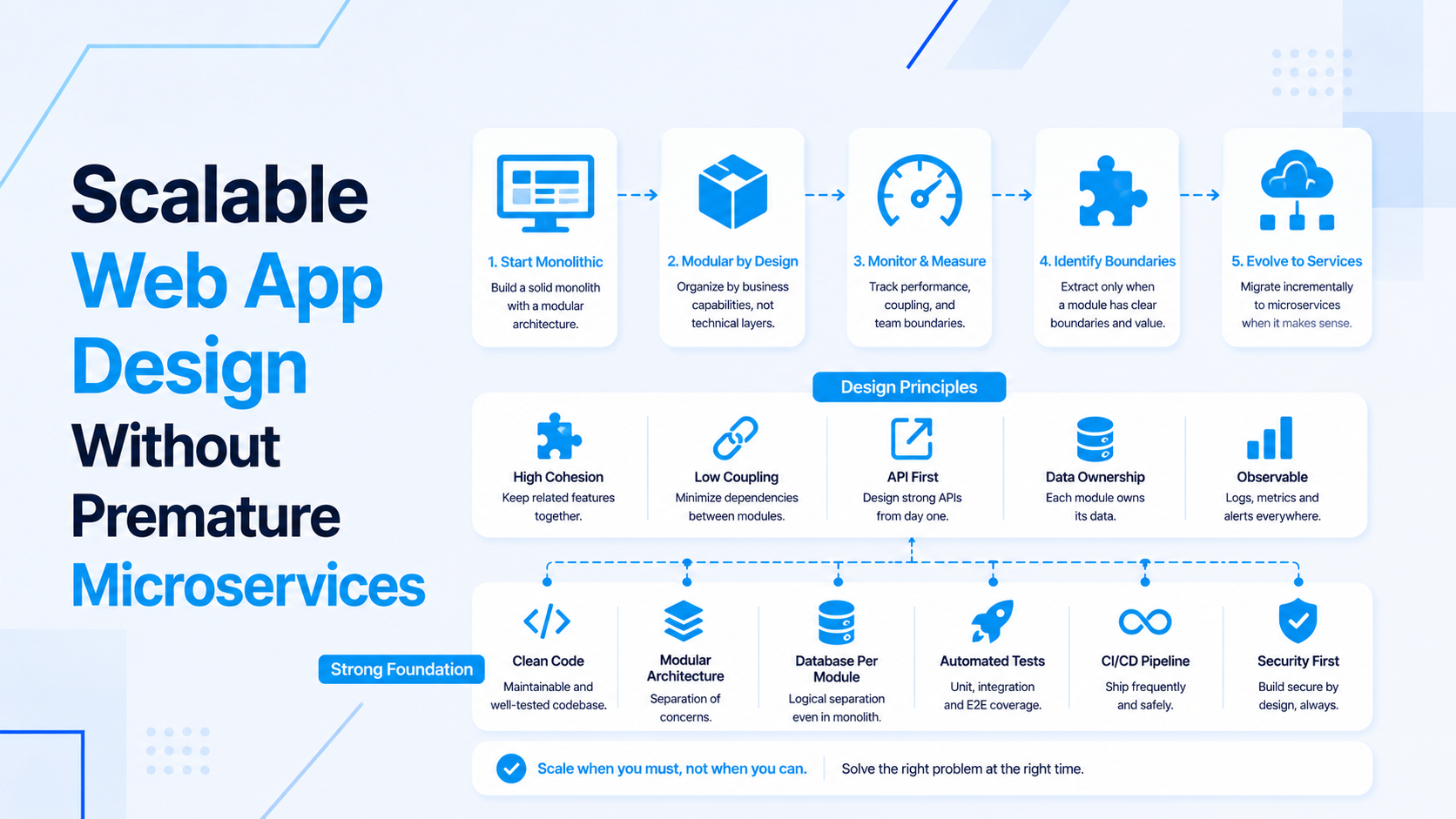
The tech industry is obsessed with microservices. Inspired by the architectures of Netflix and Uber, many startups mistakenly believe that to build a highly scalable web application, they must split their system into dozens of independent microservices from day one. This is one of the most destructive architectural mistakes a growing company can make.
Here is why premature microservices destroy developer velocity, and how to build a scalable web application using a Modular Monolith instead.
The Hidden Costs of Microservices
Microservices solve organizational scaling problems, not technical scaling problems. If you have 500 developers stepping on each other's toes, microservices let them work independently. If you have 5 developers, microservices will crush them under operational overhead.
- The Network is Not Reliable: In a monolith, calling the billing service is an in-memory function call taking nanoseconds. In a microservice architecture, it is an HTTP request over a network that can fail, timeout, or drop packets. You now have to write complex retry logic, circuit breakers, and distributed tracing just to get basic reliability.
- Distributed Transactions: If a user signs up, you need to create a User record and a Billing record. In a monolith, this is a simple database transaction. If it fails, everything rolls back. In a microservices setup, you must implement the Saga pattern to handle partial failures across different databases. This increases code complexity by 10x.
- DevOps Nightmare: Deploying one monolith is easy. Deploying, monitoring, and orchestrating 15 microservices requires a dedicated DevOps engineer managing a Kubernetes cluster. A startup should be spending its budget on product features, not Kubernetes orchestration.
The Solution: The Modular Monolith
You can achieve the scalability and code cleanliness of microservices without the network overhead by building a Modular Monolith.
A Modular Monolith is a single deployable application (e.g., one Laravel or Node.js app) where the code is strictly separated by business domains (e.g., Invoicing, Inventory, CRM) rather than technical concerns (e.g., all controllers in one folder, all models in another).
Rules of a Modular Monolith:
- Strict Boundaries: The
Inventorymodule cannot query theInvoicingdatabase tables directly. It must call a public interface or method provided by theInvoicingmodule. - Event-Driven Communication: Modules should communicate via internal events. When the
Invoicingmodule marks an invoice as paid, it dispatches anInvoicePaidinternal event. TheCRMmodule listens to this event and updates the customer's status. This loosely couples the system. - Single Deployment: The entire application is deployed together as a single unit, eliminating the complexities of versioning APIs between internal microservices.
When to Finally Extract a Microservice
You should only extract a piece of the monolith into a separate microservice when it requires drastically different scaling characteristics or technologies. For example:
- A PDF generation service that requires massive CPU spikes and specific Linux binaries.
- A real-time WebSocket notification server that requires Node.js, while the main app is PHP.
- A heavy data-analytics pipeline that would slow down the main web server.
If you are looking for pragmatic, highly scalable web application development that maximizes velocity while keeping infrastructure simple, visit my hire full-stack developer India page to discuss the modular monolith approach.

Prakash Tank
Full-Stack Architect & Tech Enthusiast. Passionate about building scalable applications and sharing knowledge with the community.