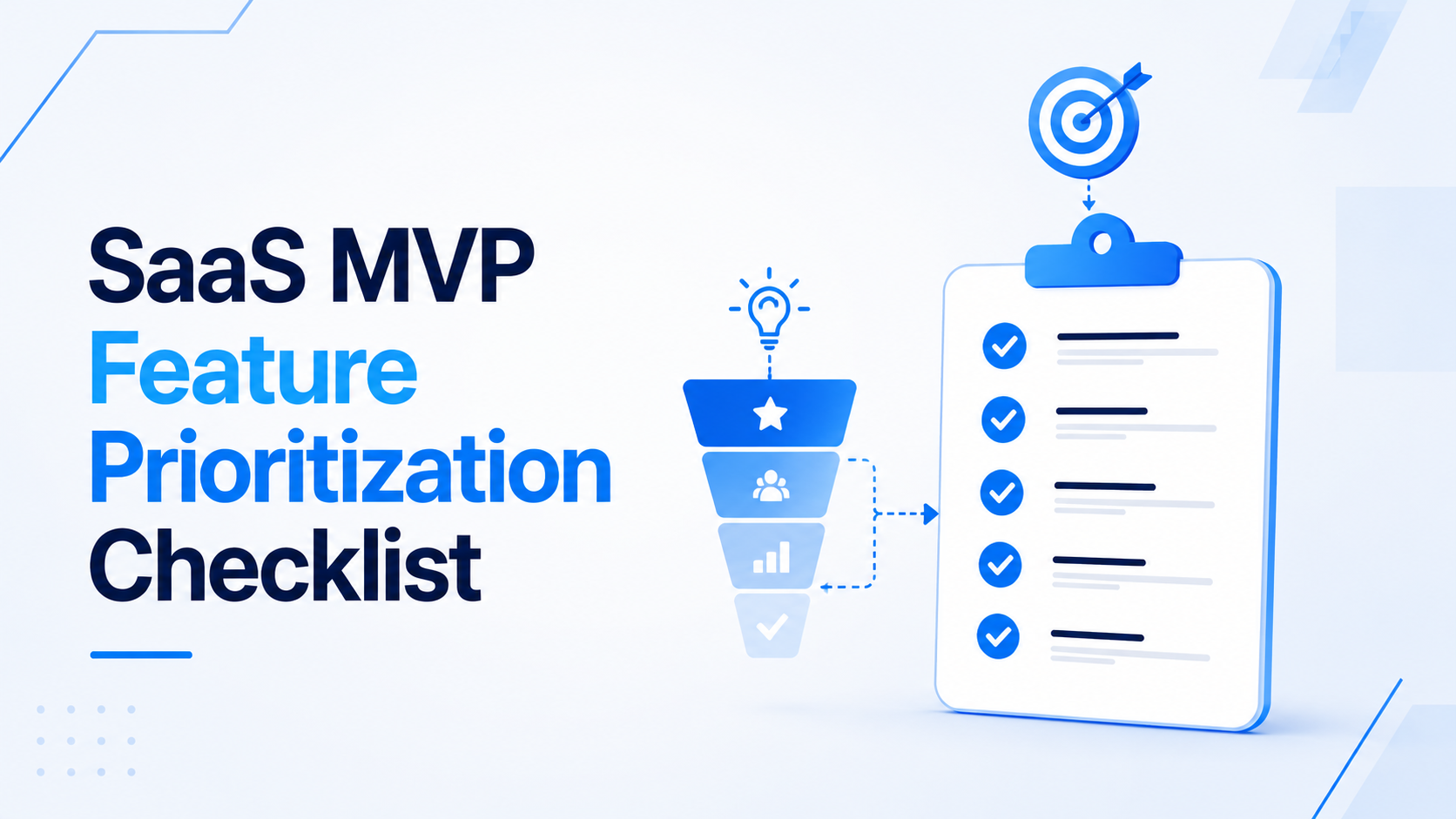
One of the most common reasons SaaS MVP launches fail is that founders try to build too much. They start with a list of 50 features, spend 12 months building 40 of them, run out of runway, and never validate whether the core idea was even viable. The cure for this is ruthless feature prioritization.
Use this checklist to evaluate every proposed feature and make hard decisions about what belongs in your MVP.
The Core Rule: What Proves the Hypothesis?
Your MVP is not a product; it is an experiment. Every feature must answer the question: "Does including this feature help us determine if someone will pay for our core value proposition?"
If a feature does not directly help answer that question, it does not belong in version 1.0.
The "Must Build" Checklist (MVP Core)
These are the non-negotiable features that every SaaS MVP requires on day one:
- User Registration and Login: Including email/password auth. Do NOT build social logins (Google/GitHub) in the MVP unless your target audience uses them exclusively.
- Email Verification: A single email to verify the user's address. This prevents fake signups and is required for GDPR compliance.
- The Core Value Feature: The single action that delivers your product's core promise. For a project management tool, this is creating and assigning a task. For an invoicing tool, this is generating and sending an invoice.
- Subscription Billing: If your SaaS is paid, you must be able to accept money on day one. Use Stripe Checkout to implement a simple paid plan in a few hours. No custom billing engine.
- Basic Account Settings: The ability to change a password and update an email address. Users will expect this on day one.
The "Defer to v2" Checklist (Features to Cut)
These are features that founders almost always include prematurely, wasting valuable engineering time:
- Custom Reporting and Analytics Dashboards: This is one of the most expensive features to build correctly. In the MVP, just export everything to CSV. This buys months of engineering time.
- Team and Collaboration Features: Building shared workspaces, permission levels, and notification systems is a massive scope. Unless collaboration is your core value proposition, build for single users first.
- API Access for Third-Party Integrations: Building a public-facing REST API with documentation and access tokens is a significant engineering effort. Wait until users actually ask for it.
- Mobile App (iOS/Android): A well-optimized, responsive web app that works on mobile browsers is sufficient for an MVP. Do not spend months building a native app before you have product-market fit.
- "Nice-to-Have" UI Polish: Dark mode, drag-and-drop reordering, custom themes. These consume enormous development time and provide zero business validation.
The Scoring Framework (MoSCoW Method)
For each proposed feature, assign one of the following labels:
- Must Have: The MVP literally cannot function without this.
- Should Have: Important but can launch without it (ship in week two post-launch).
- Could Have: Nice to have, no deadline (v2 backlog).
- Won't Have: Explicitly out of scope for this product cycle.
If more than 30% of your features are labeled "Must Have," your scope is too large. Challenge your own assumptions aggressively. A lean, focused MVP launched in 60 days beats a bloated, "complete" product launched in 12 months every single time. If you need a technical partner who will enforce this discipline, visit my hire full-stack developer India page.

Prakash Tank
Full-Stack Architect & Tech Enthusiast. Passionate about building scalable applications and sharing knowledge with the community.