As a startup founder, hiring your first software developer is a high-stakes decision. This individual (or small agency) will not just be writing code; they will be translating your business vision into a tangible product. The architecture they choose today will determine how quickly you can pivot tomorrow, and how painfully you will scale next year.
The tech market is flooded with developers. Differentiating between a "coder" who needs explicit step-by-step instructions and a "product engineer" who solves business problems is the key to startup success. Here is what to look for before making that critical hire.
1. Product Pragmatism Over Tech Obsession
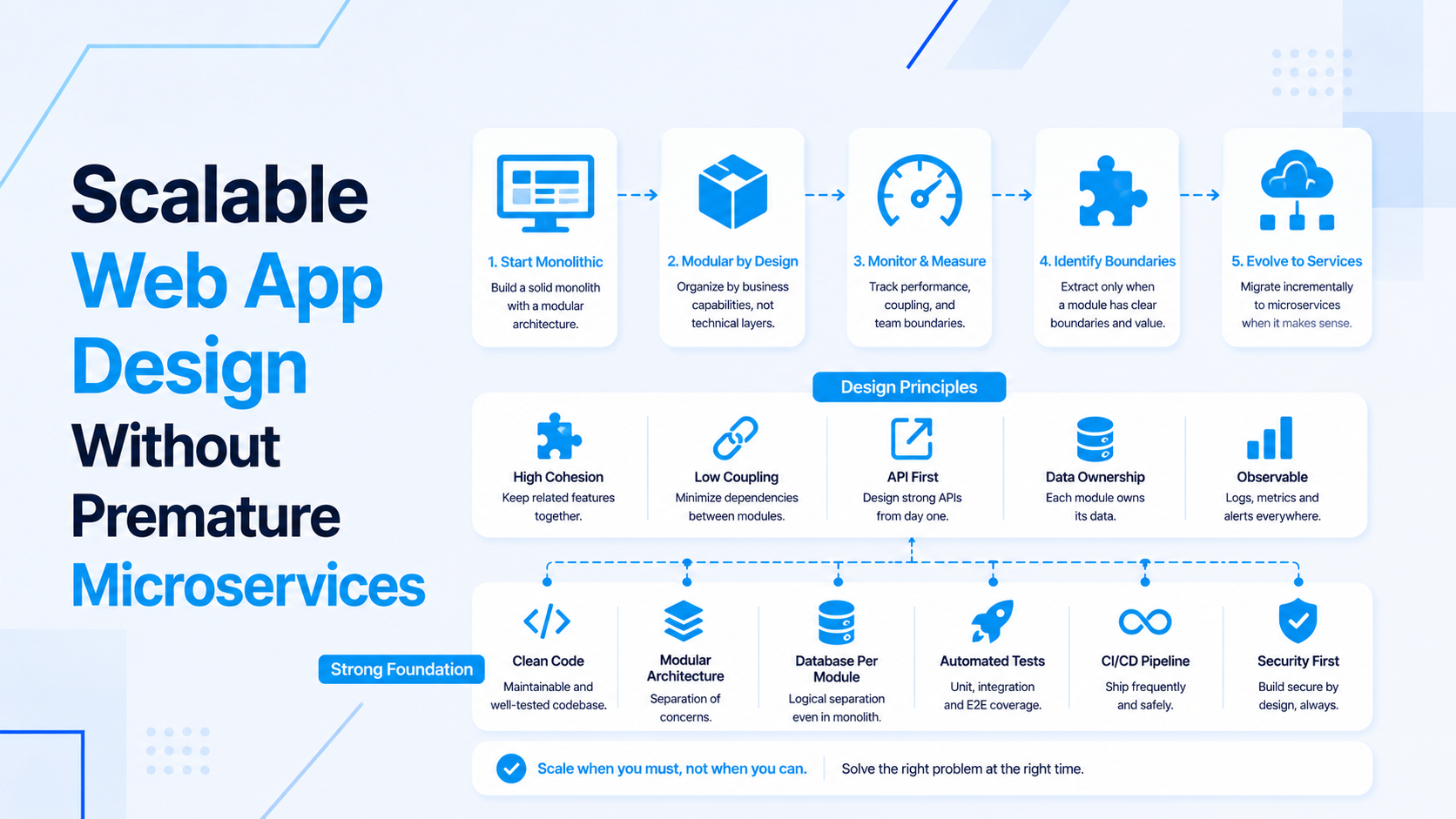
Many developers are obsessed with the "new shiny thing" (microservices, blockchain, obscure new JavaScript frameworks). For a startup, this is dangerous.
- The Red Flag: A developer who insists on building a multi-server Kubernetes microservice architecture for an MVP that expects 100 users in its first month.
- The Green Flag: A developer who suggests using established, boring technology (like a monolithic Laravel or Node.js application, or integrating third-party tools like Stripe and Auth0) to get the product to market in 60 days instead of 6 months.
- The Interview Question: "If we have 6 weeks to launch our MVP, what features from our list would you recommend cutting or simplifying?"
2. Full-Stack Fluency
Early-stage startups rarely have the budget or coordination bandwidth to hire a dedicated frontend developer, a dedicated backend developer, and a DevOps engineer. You need a Full-Stack Developer.
They don't need to be world-class experts in every layer, but they must be competent enough to build a React dashboard, design a PostgreSQL database schema, write the Node.js or Laravel API, and deploy it to a server (like AWS or DigitalOcean). If a developer says, "I only do the frontend, you'll need to hire someone to make the API," they are not the right fit for your first hire.
3. Deep Understanding of Data and Domain Modeling
The frontend UI is just paint; it can easily be changed later. The database schema (how your data is structured and related) is the foundation of the house. If the foundation is flawed, the house will eventually collapse.
- Look for: A developer who asks deep, probing questions about your business rules before they write a line of code.
- Example: If you are building a marketplace, they should immediately ask: "Can a user be both a buyer and a seller with the same account?" or "How do we handle refunds if the seller has already withdrawn the money?" Their ability to translate these business edge cases into database relationships is critical.
4. Focus on Security and Multi-Tenancy
If you are building a B2B SaaS product, your application is multi-tenant (many companies using one software instance). Data isolation is paramount. A simple coding mistake could result in Company A seeing Company B's financial data—a startup-ending disaster.
During the vetting process, ask them directly how they enforce data isolation. If they say "we just filter by ID on the frontend," walk away immediately. They must understand backend row-level security or strict middleware enforcement.
5. Communication and "Pushback"
As a founder, you are the domain expert of your industry, but you may not be a software expert. You will inevitably suggest a feature that is technically complex but provides low business value.
You do not want a "Yes Man" developer who blindly builds whatever you ask for, burns through your runway, and delivers a bloated product 6 months late. You want a developer who pushes back: "That custom reporting feature will take 3 weeks to build. What if we just allow users to export to CSV for the MVP? That will take me 2 hours."
Conclusion
Hiring for a startup is about finding a technical partner, not just a pair of typing hands. You need someone who balances code quality with time-to-market. If you are a founder looking for a dedicated developer who understands both the technology and the business of startups, visit my hire full-stack developer India page to discuss how we can build your product.

Prakash Tank
Full-Stack Architect & Tech Enthusiast. Passionate about building scalable applications and sharing knowledge with the community.