A startup MVP should not be overbuilt, but it should avoid decisions that make the next version painful. Good MVP architecture keeps the first release simple while preserving clean paths for scaling, refactoring, and product learning.
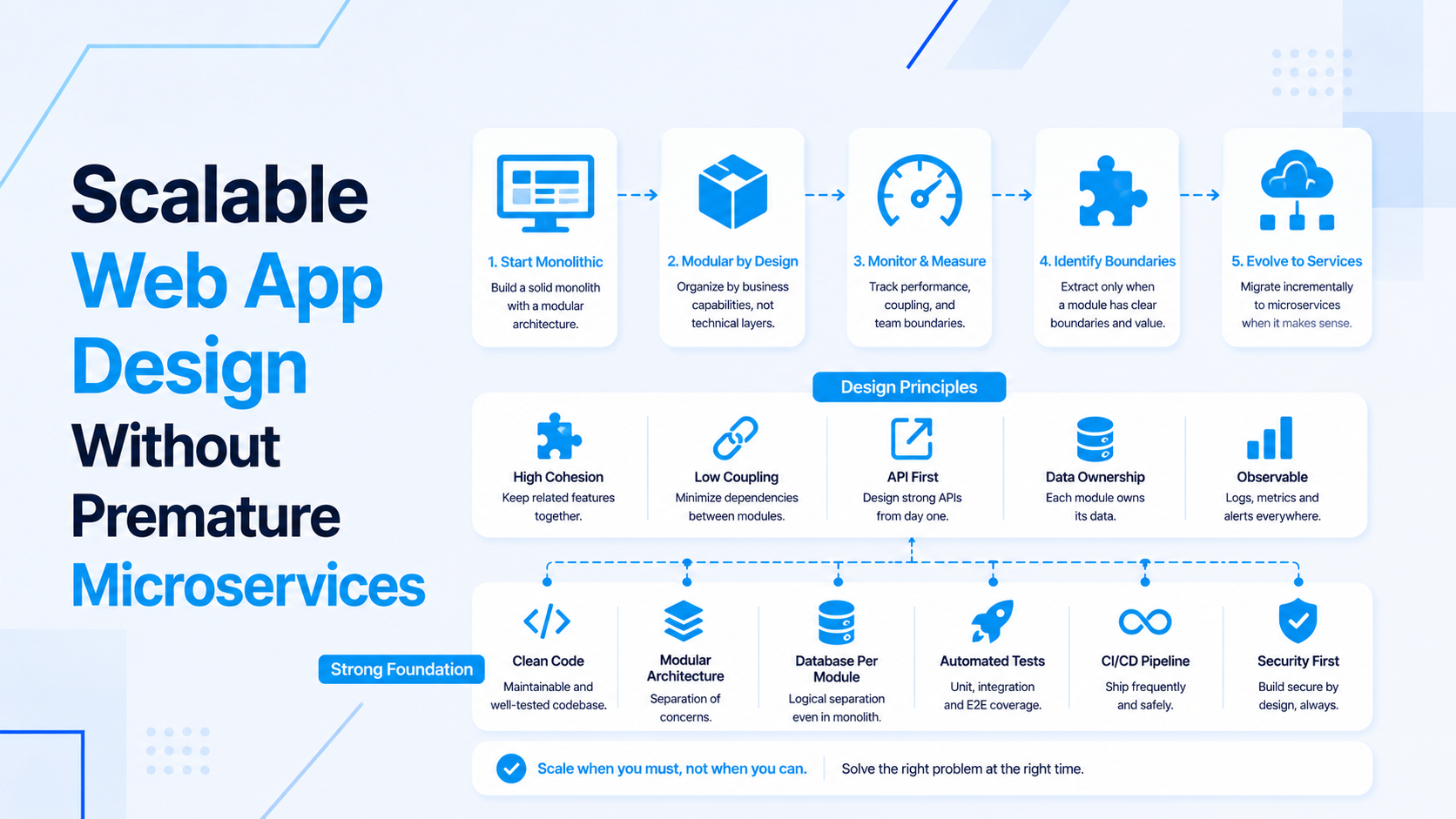
Prefer A Modular First Application
- Use clear modules for accounts, users, billing, dashboards, workflows, integrations, and admin tools.
- Keep controllers and routes thin.
- Move business logic into services, actions, jobs, or domain classes where useful.
- Delay microservices until boundaries and operational needs are real.
For a related scaling view, read scaling React Node.js products without premature microservices.
API And Database Foundations
- Define API contracts around the frontend workflow.
- Use validation, authorization, and consistent error responses.
- Model ownership, statuses, relationships, and audit needs early.
- Add indexes for common lookup and dashboard paths.
For backend support, review backend API development and database optimization.
Queues, Caching, And Observability
- Use queues for email, imports, exports, notifications, reports, and integration retries.
- Cache only where freshness rules are clear.
- Log errors, failed jobs, slow endpoints, and integration failures.
- Prepare staging, backups, and deployment steps.
For deployment planning, include cloud infrastructure development.
Final Architecture Rule
Build the MVP with clean boundaries, not heavy machinery. The architecture should let the product learn quickly, fix safely, and scale when evidence says it is time.

Prakash Tank
Full-Stack Architect & Tech Enthusiast. Passionate about building scalable applications and sharing knowledge with the community.