A SaaS MVP should prove a product workflow, not demonstrate every possible architecture pattern. The first release needs enough structure to support real users, but not so much complexity that the product takes months longer than necessary to launch.
This guide explains how to build a SaaS MVP without overengineering the first release. It is written for founders and product teams that need practical scope, clean architecture, and a path to improve after customer feedback.
Define The First Customer Outcome
The MVP should focus on one valuable customer outcome. If that outcome is unclear, the application will collect features instead of proving demand.
- Write the main workflow from signup to the customer's first useful result.
- Identify the smallest dashboard, report, automation, or collaboration flow that proves value.
- Separate must-have launch features from future roadmap ideas.
- Define what the customer must be able to do without manual support.
- Keep admin/support tools only as strong as the first release requires.
Before implementation, use the SaaS application developer checklist for founders to make sure the product scope is ready.
Choose Boring Architecture First
Boring architecture is often the best MVP architecture. A clear Laravel, Node.js, or full-stack application can launch faster and be easier to debug than a distributed system built too early.
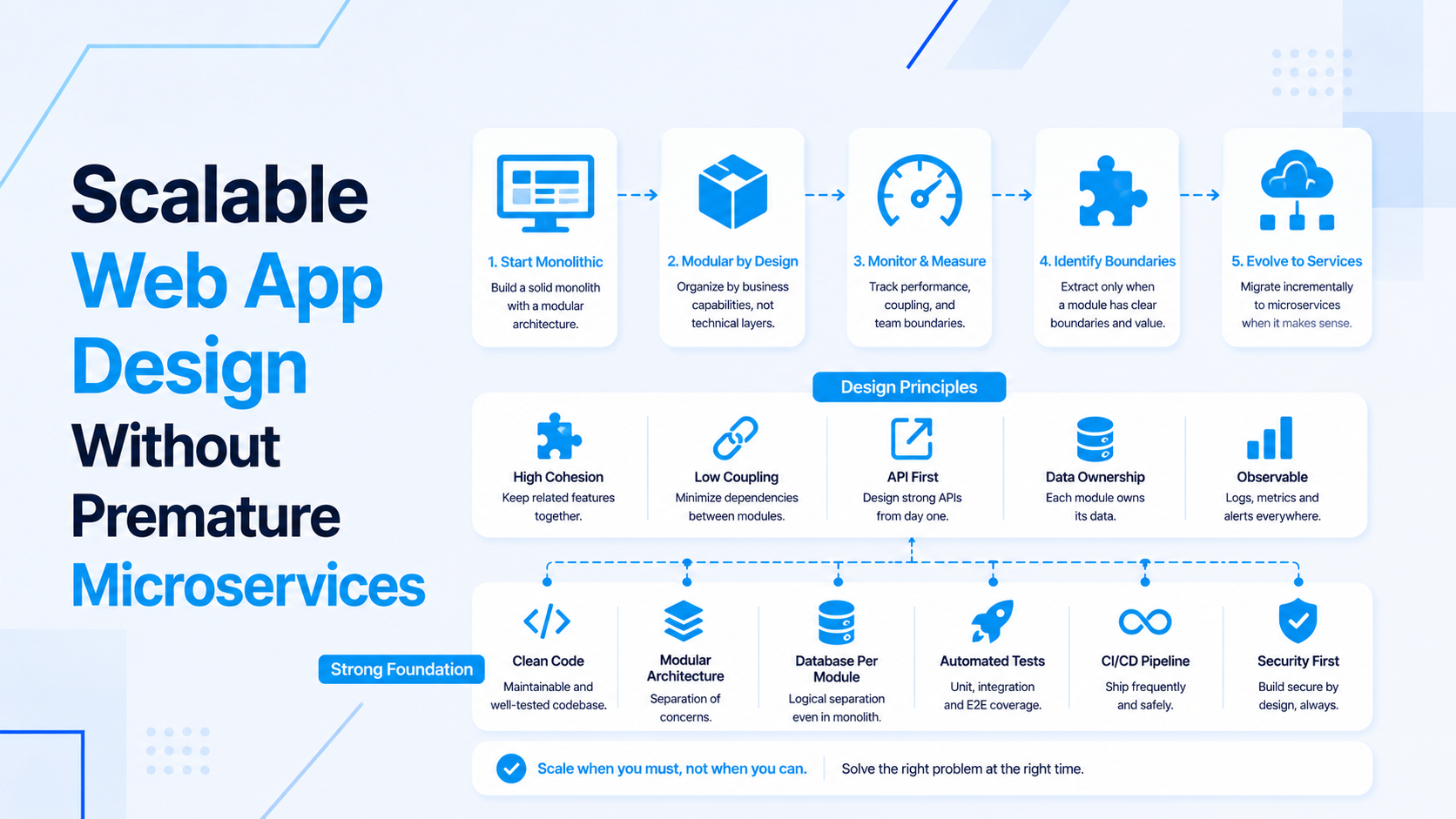
- Use a modular monolith before microservices unless independent service boundaries are already obvious.
- Keep business logic organized by product domain.
- Use clear API contracts for frontend screens.
- Move slow work into queues instead of splitting services prematurely.
- Document the decisions that will be hard to change later.
For the deeper architecture baseline, review SaaS architecture basics and scaling React Node.js products without premature microservices.
Keep Tenancy And Roles Simple
Even a small SaaS MVP needs account boundaries, but the permission model should stay practical.
- Decide whether the MVP uses personal accounts, workspaces, teams, or organizations.
- Start with the smallest role set that protects important actions.
- Scope every customer-owned record by account or workspace.
- Protect billing, user invites, exports, deletes, and admin actions on the backend.
- Delay custom permission builders until real customers need them.
Billing: Launch With The Right Amount
Billing can become a rabbit hole. The MVP needs enough billing structure to support your business model, not every possible pricing experiment.
- Define plans, trials, payment status, cancellation, and failed payment behavior.
- Keep paid feature access enforced server-side.
- Record payment provider IDs and webhook events for support.
- Delay complex usage billing until usage patterns are proven.
- Make manual admin correction possible for early customer support.
If Laravel is the backend choice, Laravel development services can support subscription flows, admin panels, and API-backed billing features.
Build Only The Dashboards Users Need First
Dashboards are easy to overbuild. Start with screens that help users complete the first workflow and understand whether the product is working.
- Build the core user dashboard before advanced analytics.
- Use simple metrics before custom report builders.
- Prefer clear empty states over decorative charts.
- Add exports only when users need them for the first workflow.
- Keep admin dashboards focused on support and operational visibility.
For frontend-heavy SaaS products, include React and Next.js development early so API and UI decisions line up.
Use Queues For Slow Work
Queues are a good MVP investment because they protect user experience without forcing a large architecture.
- Use background jobs for emails, imports, exports, report generation, webhooks, and payment syncs.
- Show job status when users are waiting for results.
- Log job failures with enough context to support customers.
- Keep retries idempotent for billing and integration work.
- Monitor queue workers before launch.
For backend scope, pair queues with backend API development and database design.
Delay These Until The Product Proves Demand
- Microservices without clear independent scaling or team boundaries.
- Custom workflow builders before the main workflow is stable.
- Advanced analytics before basic dashboard usage is proven.
- Complex usage billing before customers understand the value metric.
- Multi-region infrastructure before traffic and compliance require it.
- Deep role customization before real permission needs are known.
MVP Launch Checklist
- Signup, onboarding, primary workflow, billing, and support paths are tested.
- Tenant data isolation and permissions are covered by backend checks.
- Critical queues, emails, webhooks, storage, and scheduled jobs are configured.
- Logs, backups, rollback notes, and deployment steps are ready.
- Analytics capture enough data to learn what users actually do.
- Post-launch fixes and roadmap decisions have an owner.
If deployment is part of the first release, include cloud infrastructure development before launch day.
Final Rule: Build For Learning And Stability
A good SaaS MVP is small, stable, and honest about what it is trying to prove. It should give customers a real outcome and give the founder enough evidence to decide what to build next.
If you need help planning or building the first SaaS release, start with full-stack product development, then map frontend, backend, database, billing, queues, and deployment into the smallest useful launch.

Prakash Tank
Full-Stack Architect & Tech Enthusiast. Passionate about building scalable applications and sharing knowledge with the community.