The demand for engineers who can integrate Artificial Intelligence into commercial products has surged. But transitioning into a **Python AI Developer** role does not require a PhD in Machine Learning. For full-stack software engineers, the key is mastering the application layer of AI: API orchestration, embeddings, vector databases, RAG pipelines, and agentic workflows.
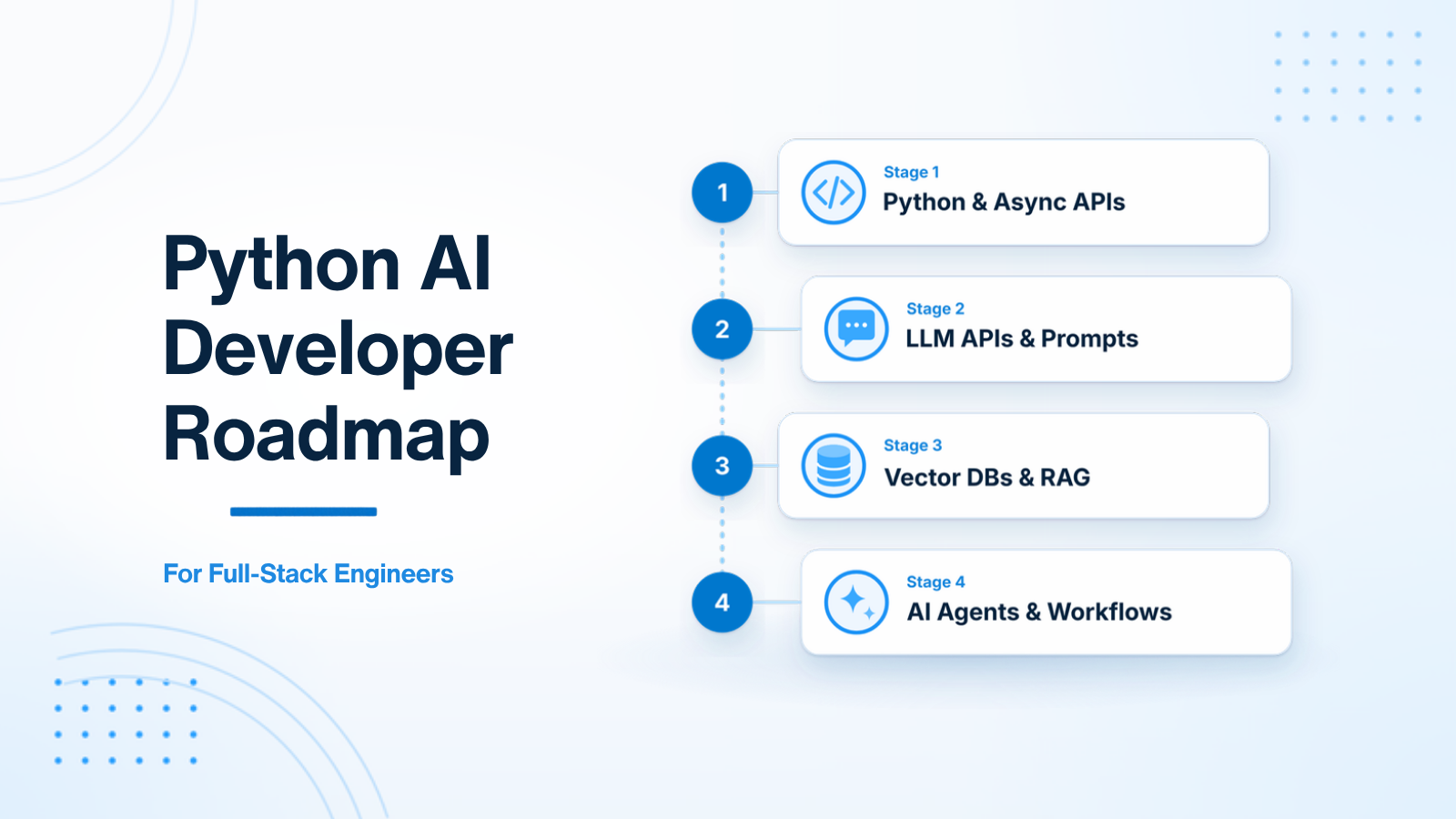
The 4-Stage Learning Roadmap
Stage 1: Python Mastery & Async APIs
- Master modern Python 3.11+, type hints, Pydantic v2, and
asyncio. - Build high-performance REST APIs with FastAPI.
Stage 2: LLM API Integration & Prompt Engineering
- Learn OpenAI, Anthropic, and Google Gemini SDKs.
- Master structured JSON outputs (Function Calling / Tool Calling).
- Implement token usage tracking and prompt caching.
Stage 3: Vector Databases & RAG Pipelines
- Understand text embeddings (
text-embedding-3-small). - Learn vector databases: pgvector, Pinecone, or Chroma.
- Build complete Retrieval-Augmented Generation (RAG) pipelines for private data.
Stage 4: AI Agents & Workflows (LangGraph)
- Master graph-based state machine agents using LangGraph.
- Implement multi-agent workflows with human-in-the-loop approvals.
Summary
By building real-world AI applications on top of Python and FastAPI, you bridge the gap between traditional full-stack development and modern AI engineering.
Looking for a Python AI engineer to build your next feature? Visit my AI integration development page or Hire AI Developer.

Prakash Tank
Full-Stack Architect & Tech Enthusiast. Passionate about building scalable applications and sharing knowledge with the community.