LLM Application Development: Prompts, Tools, Memory & Evals

Design applications around large language models with clear architecture: prompt versions, tool contracts, retrieval, memory boundaries, observability, and evaluation.

LLM applications need architecture, not only clever prompts.

An LLM feature becomes a product when prompts, tools, memory, retrieval, logging, and evaluation are designed together. Otherwise you get demos that break under real users.

I help teams build LLM applications with those pieces explicit: versioned prompts, safe tool contracts, memory boundaries, optional RAG, and observability for cost and quality.

Based in Ahmedabad, I deliver across Laravel, Node, React, and FastAPI so the LLM layer fits the product instead of becoming a side experiment.

If your focus is content-style GenAI features, see Generative AI Development. If knowledge grounding is central, see RAG Development.

What this page covers

  • LLM application development
  • Prompt systems and versioning
  • Tools and function calling
  • Memory boundaries
  • Retrieval and citations
  • Logging, tokens, and evals

Tools and stack

What I use to ship this kind of AI work.

LLM Application Development LLM App Architecture Prompt Engineering Production LLM Tool Calling LLM Memory Design LLM Evaluation LLM Observability OpenAI Application Development Claude Application Development RAG + LLM Apps Laravel LLM Integration FastAPI LLM Services Production LLM Systems Hire LLM Developer

Capabilities

What you get when we build this AI workflow for your product.

Prompt systems, not one-off strings

Version prompts, separate system and user roles, and keep templates reviewable by product owners.

Tools and function calling

Define tool contracts so the model can look up or act without open-ended chaos.

Memory with boundaries

Decide what is session memory, what is durable user memory, and what must never be stored.

Retrieval when knowledge matters

Add RAG when answers must follow your corpus, with citations and weak-hit behavior.

Logging and token economics

Trace requests, measure latency and spend, and keep privacy-safe telemetry.

Evaluation loops

Maintain golden examples, regression checks, and human review signals as the app evolves.

Engagement models

Project, MVP sprint, or dedicated hire depending on roadmap urgency.

FAQs

Common questions about scope, architecture, and how to start.

Building product software around large language models with architecture for prompts, tools, memory, retrieval, logging, and evaluation.

No. Prompts matter, but production apps also need APIs, storage boundaries, tool safety, observability, and evals.

No. Use RAG when private or changing knowledge must ground answers. Skip it for pure transform tasks with clear inputs.

Explicitly. Session context, durable preferences, and forbidden data are designed as product decisions, not accidental chat logs.

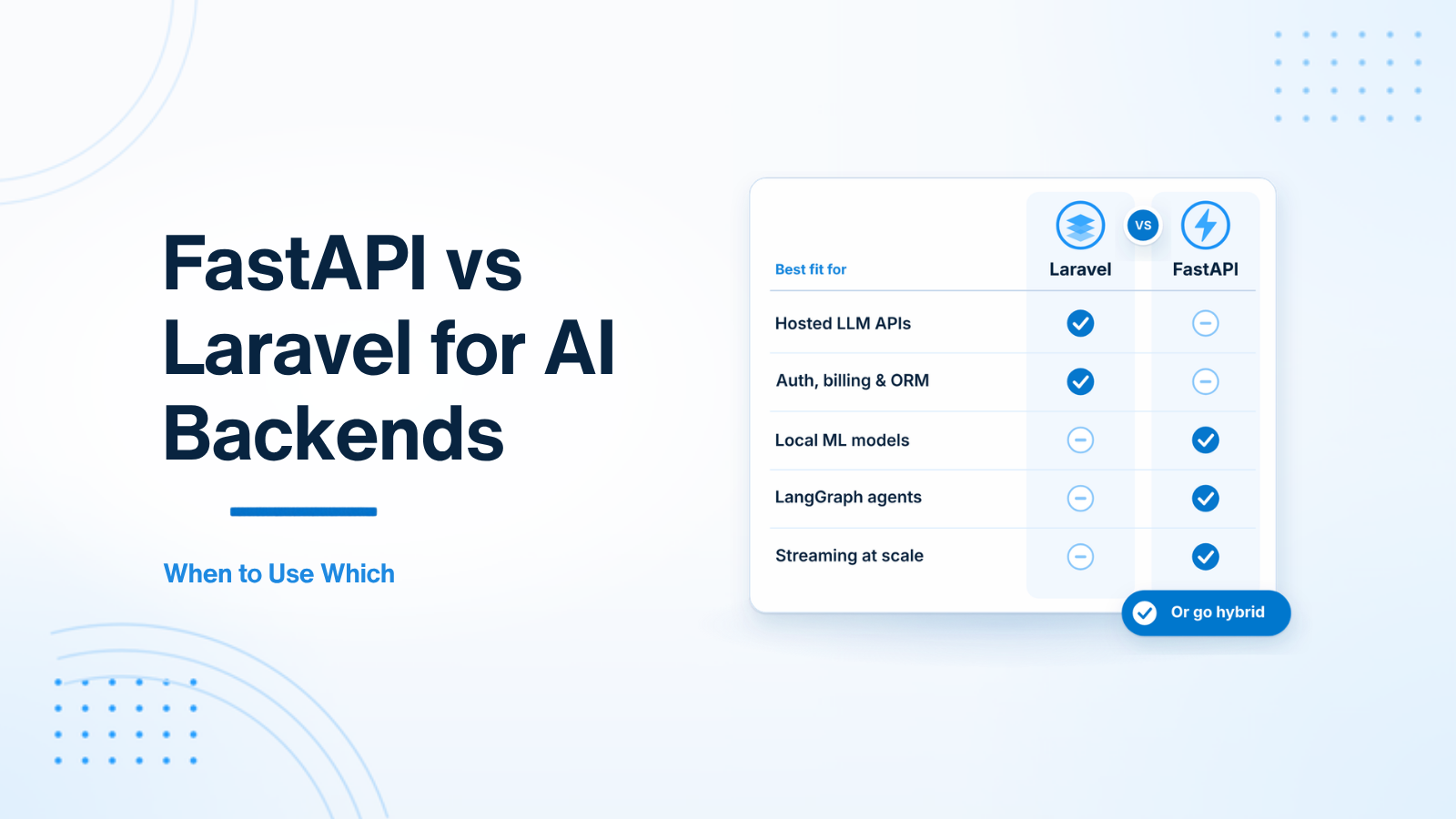
Yes. Laravel or Node often own product UX and auth; FastAPI can own heavy LLM workers when Python tooling helps.

Share the user job-to-be-done, data sources, and risk level. Hire AI Developer or contact with category AI.