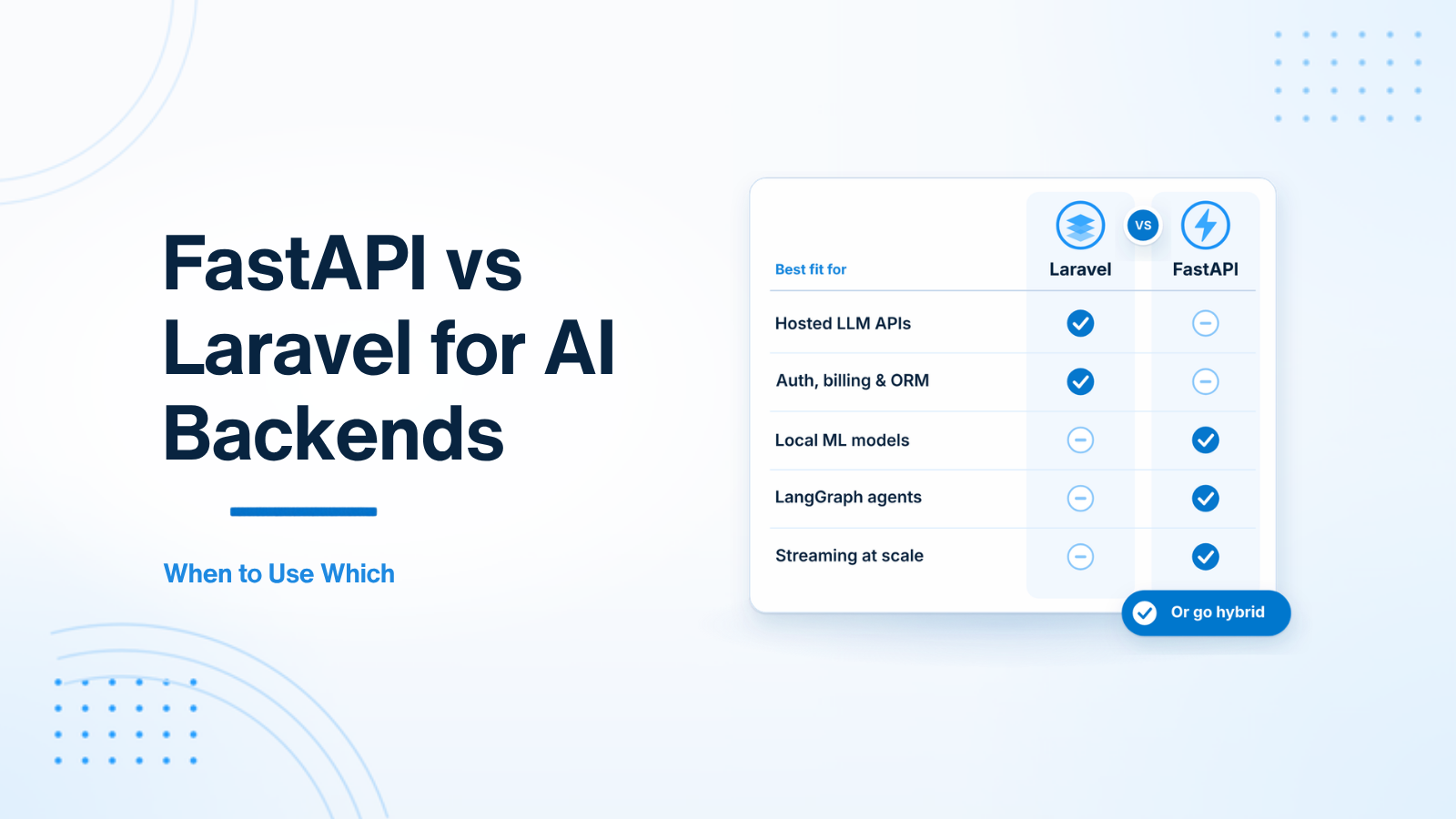
When full-stack software developers and engineering teams start building AI-powered features into commercial products, they hit an immediate architectural crossroads: Should we build AI features directly inside our existing Laravel application, or should we introduce a separate Python FastAPI microservice?
Both frameworks are exceptionally capable, battle-tested in production, and widely adopted across the software industry. However, choosing the wrong architecture for your specific business stage can introduce months of unnecessary infrastructure complexity — or force a painful codebase migration down the road. This comprehensive guide provides technical founders, software architects, and backend engineers with a concrete decision framework based on real-world production setups.
1. Understanding the Core Framework Philosophies
Laravel and FastAPI serve fundamentally different roles in the modern web development ecosystem:
Laravel (PHP): A full-stack web application framework designed around developer productivity, convention over configuration, and a massive batteries-included ecosystem. It provides first-party solutions for database migrations, Eloquent ORM, background queues via Laravel Horizon, session authentication, API token management via Sanctum, task scheduling, live reactive views via Livewire, and administrative dashboards. It excels at managing complex domain business logic, relational databases, user authorization roles, billing integrations, and rich user web interfaces.
FastAPI (Python): A lightweight, ultra-high-performance asynchronous micro-framework built around Python 3.8+ type hints, automatic Pydantic data validation, and OpenAPI documentation generation. It is designed specifically for asynchronous computational workloads, high-throughput microservices, data processing pipelines, and RESTful API endpoints.
The primary reason this framework debate arises is that 95% of the machine learning and artificial intelligence ecosystem — PyTorch, Hugging Face transformers, LangChain, LangGraph, sentence-transformers, scikit-learn, OpenCV, SciPy — is written natively in Python. The architectural question is not which framework is inherently "better," but rather how much native Python machine learning execution your product genuinely requires in order to deliver its core value proposition.
2. Detailed Architectural Comparison
Here is how Laravel and FastAPI compare across core application engineering requirements in an AI-first product:
| Evaluation Dimension | Laravel Direct Integration | FastAPI Dedicated Service |
|---|---|---|
| Primary AI Use Case | Hosted LLM API Orchestration (OpenAI, Claude, Gemini) | Local ML Models, Custom Embeddings, LangGraph Agents |
| Database & Auth Integration | Native Eloquent ORM, Session/Sanctum Auth, Migrations | Requires SQLAlchemy setup & JWT handling |
| ML Library Access | Restricted to REST API wrappers | Native access to PyTorch, Hugging Face, SciPy |
| Concurrency Model | PHP-FPM worker pool / Octane (Swoole) | Native `asyncio` event loop (High concurrency) |
| Operational Overhead | Single codebase, simple deployment | Requires separate Docker container & CI/CD pipeline |
3. When to Use Laravel Directly (The Monolithic Advantage)
If your AI feature relies primarily on hosted cloud LLM APIs (such as OpenAI's GPT-4o, Anthropic Claude 3.5, or Google Gemini Pro), you do not need Python in your stack at all. Laravel can orchestrate these API calls with extreme efficiency and unmatched developer speed.
Building inside Laravel allows software developers to leverage existing application infrastructure directly. You do not need to create secondary database connections, replicate user authentication schemas, or configure cross-service authentication headers. Everything executes within your established transactional boundaries.
Choose Laravel Direct Integration when:
- You are orchestrating cloud APIs only: Calling OpenAI's REST API or sending prompt payloads via HTTP clients is fundamentally a network I/O task. PHP handles REST HTTP requests just as easily and fast as Python.
- Your logic is prompt-driven: If the intelligence lives inside the cloud model and your backend's job is formatting prompt templates, storing user inputs, and saving JSON responses to MySQL/PostgreSQL, Eloquent handles this seamlessly without needing an extra service layer.
- You need deep transactional database logic: If an AI action must read user permissions, update database records inside a SQL transaction, and dispatch queued background notifications (via Laravel Horizon), keeping this logic inside a single Laravel codebase avoids cross-service network latency and distributed data inconsistencies.
- Your team is Laravel-first: Introducing Python microservices into a PHP-focused engineering team introduces separate Dockerfiles, dependency management tooling (Poetry/uv), separate monitoring pipelines, and mental context-switching overhead.
// Example: Safe AI processing inside a Laravel Job
class ProcessAiDraftJob implements ShouldQueue
{
    use Dispatchable, InteractsWithQueue, Queueable, SerializesModels;

    public function __construct(public Ticket $ticket) {}

    public function handle(OpenAiService $ai): void
    {
        // 1. Fetch data via Eloquent
        $context = $this->ticket->getFormattedHistory();

        // 2. Execute OpenAI REST API call
        $draft = $ai->generateResponseDraft($context);

        // 3. Save directly within database transaction
        $this->ticket->update(['ai_draft_reply' => $draft]);
    }
}
4. When to Use FastAPI (The Python ML Path)
You should introduce a dedicated Python FastAPI service when your product requires features that depend directly on the native Python machine learning ecosystem.
FastAPI provides an asynchronous non-blocking event loop that excels at streaming responses to frontend user interfaces. Furthermore, FastAPI integrates natively with Pydantic, enabling strict input data validation and automatic OpenAPI client generation.
Choose FastAPI when:
- You are running open-source or local models: If you run local embedding models (e.g.
sentence-transformers/all-MiniLM-L6-v2), Hugging Face transformers, PyTorch inference, or local OCR models (Tesseract, PaddleOCR), you require Python. - You need LangChain or LangGraph agent state machines: Building multi-agent workflows with state checkpoints, conditional branching loops, and tool execution is best achieved using Python agent frameworks.
- You are building custom vector retrieval pipelines: If document chunking, semantic re-ranking, and vector mathematical transformations happen in-memory before vector database upsert, Python provides superior tooling and native matrix execution speed.
- You require high-throughput streaming concurrency: FastAPI's native
asyncioevent loop handles thousands of concurrent Server-Sent Events (SSE) streaming connections efficiently for real-time AI chat interfaces.
# Example: FastAPI microservice for local document embeddings
from fastapi import FastAPI
from pydantic import BaseModel
from sentence_transformers import SentenceTransformer

app = FastAPI()
model = SentenceTransformer("all-MiniLM-L6-v2")

class EmbeddingRequest(BaseModel):
    texts: list[str]

@app.post("/api/v1/embed")
async def generate_embeddings(payload: EmbeddingRequest):
    # Generates 384-dimensional vector embeddings locally
    vectors = model.encode(payload.texts).tolist()
    return {"vectors": vectors}
5. The Pragmatic Hybrid Architecture
For growing mid-size SaaS products, the most popular production architecture is Hybrid: Use Laravel as your primary web monolith (handling user authentication, billing, database persistence, and UI rendering), and extract a focused FastAPI microservice specifically for heavy AI/ML pipelines.
Communication between Laravel and FastAPI happens asynchronously via queue jobs and HTTP/REST webhooks, keeping your web application responsive while letting Python execute complex AI operations.
For example, when a user uploads a PDF document in Laravel: Laravel stores the file in AWS S3 and dispatches a background job. The job sends an HTTP request to FastAPI containing the document URL. FastAPI downloads the file, chunks the text, computes PyTorch embeddings, upserts vectors into pgvector, and sends an HTTP webhook back to Laravel notifying that processing is complete. This architecture preserves Laravel's rapid web development speed while unlocking Python's advanced AI capabilities.
6. Infrastructure & Deployment Trade-offs in Production
Deploying a dual-framework hybrid architecture introduces specific operational trade-offs that software architects must evaluate carefully. Operating a monolithic Laravel application on traditional cloud infrastructure (such as AWS Elastic Beanstalk or Laravel Forge) requires managing web server worker pools, database connection pools, and Redis queue workers. Introducing a secondary Python FastAPI microservice expands your DevOps scope to include separate Docker container registries, Kubernetes deployment manifests or ECS task definitions, cross-service secret management, and distributed tracing instrumentation.
Furthermore, cross-service networking latency must be minimized using low-latency internal cloud networks or asynchronous queue messaging systems. Passing large payloads (such as high-resolution images or large document buffers) across network boundaries introduces bandwidth overhead. Modern hybrid setups optimize performance by storing large media artifacts in shared S3 bucket object stores, passing lightweight object URLs between Laravel and FastAPI microservices rather than transferring raw binary streams across HTTP endpoints.
7. Performance & Scale Considerations
When comparing raw HTTP throughput, FastAPI running on Uvicorn with asyncio can process high numbers of concurrent idle connections (such as streaming LLM responses). On the other hand, Laravel running on Laravel Octane (powered by Swoole or RoadRunner) keeps the application in memory, bringing PHP performance remarkably close to compiled languages. Therefore, raw performance alone is rarely a reason to avoid Laravel unless you specifically require Python-native CUDA computational bindings.
8. Managing Cross-Service Authentication & Security Tokens
When implementing a hybrid architecture where a PHP Laravel web monolith delegates machine learning tasks to a Python FastAPI microservice, securing cross-service network communication is paramount. Unprotected microservice HTTP endpoints expose private data pipelines to unauthorized internal network traffic or external injection attacks.
The standard enterprise pattern uses Asymmetric JWT (JSON Web Tokens) or Shared HMAC Signature Verification. When Laravel dispatches an HTTP request to FastAPI, it attaches a cryptographically signed HMAC header generated using a shared secret key and a timestamp payload. The FastAPI middleware inspects the request signature, validates the timestamp within a 60-second execution window to prevent replay attacks, and verifies that the requesting service is authenticated.
9. Handling Distributed Queue Jobs and Webhook Callbacks
Because artificial intelligence processing can take anywhere from 3 seconds to 2 minutes, synchronously blocking HTTP web worker threads during microservice calls degrades web application throughput. In production setups, decouple service execution using asynchronous queues.
Conclusion
Do not over-engineer early. If your product uses hosted cloud LLM APIs, start monolithic inside Laravel. When your feature set demands local models, LangGraph agents, or PyTorch inference, extract a modular FastAPI service.
Need help choosing or building the ideal AI backend architecture? Visit Python AI Development, AI Integration Services, or Hire AI Developer.

Prakash Tank
Full-Stack Architect & Tech Enthusiast. Passionate about building scalable applications and sharing knowledge with the community.


