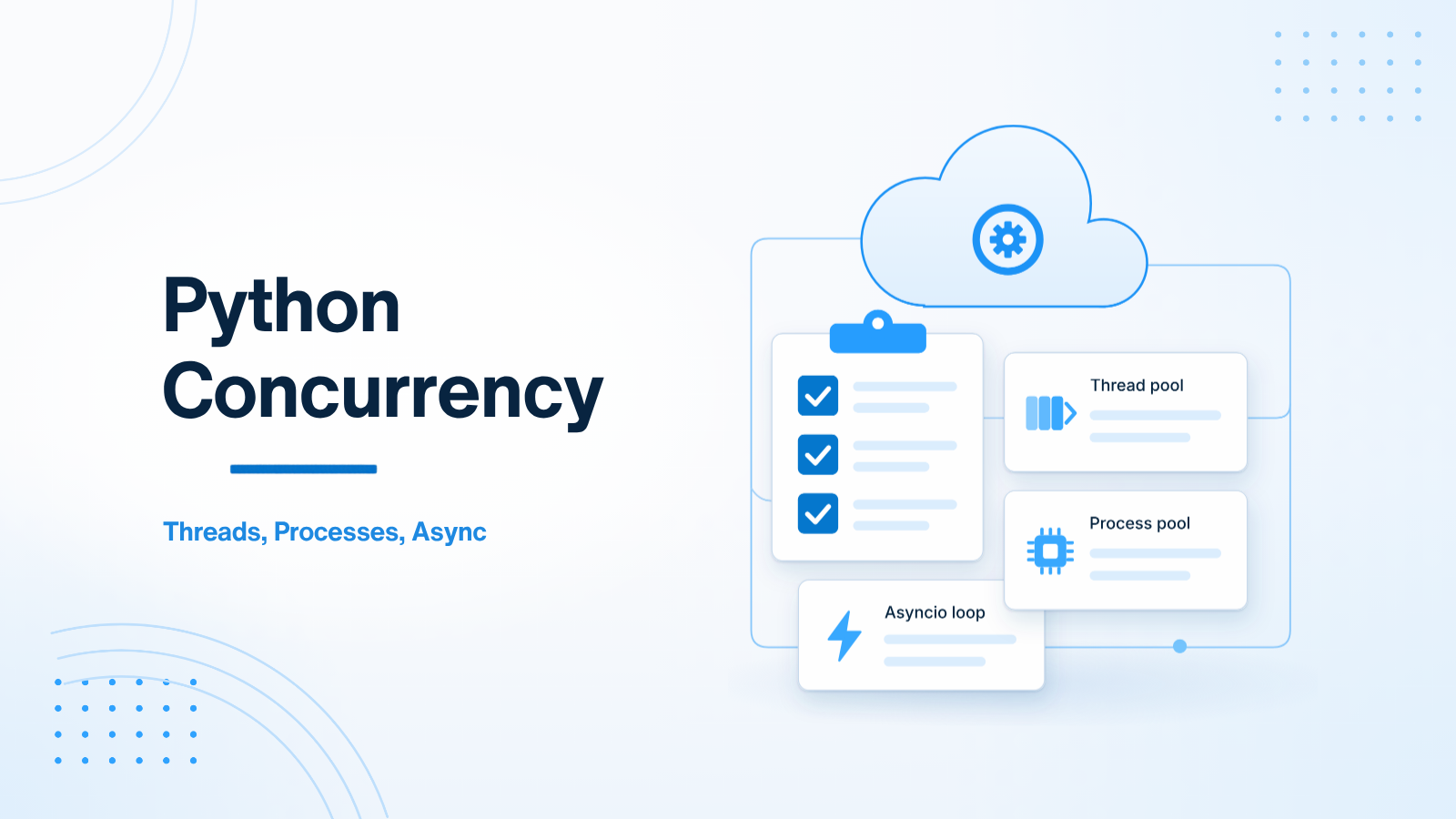
For years, Python had a reputation for being slow or single-threaded due to the Global Interpreter Lock (GIL). However, for I/O-bound workloads — such as waiting for database queries, third-party REST APIs, or LLM completions from OpenAI — Async Python (asyncio) allows a single Python process to handle thousands of concurrent operations effortlessly.
1. The Event Loop Mental Model
Imagine a restaurant waiter. In a synchronous model, the waiter takes Order A to the kitchen, stands at the kitchen counter doing nothing while the food cooks, delivers the plate to Customer A, and only then takes Order B. This is blocking I/O.
In an asynchronous model, the waiter takes Order A to the kitchen, immediately turns around to take Order B while Meal A is cooking, and picks up Meal A when the chef signals it is ready. This is non-blocking I/O managed by Python's Event Loop.
2. async and await Syntax
import asyncio
import httpx

async def fetch_pokemon(name: str) -> dict:
    async with httpx.AsyncClient() as client:
        # Yields execution control back to event loop while waiting for network response
        response = await client.get(f"https://pokeapi.co/api/v2/pokemon/{name}")
        return response.json()

async def main():
    # Fetch 3 pokemon concurrently
    results = await asyncio.gather(
        fetch_pokemon("ditto"),
        fetch_pokemon("pikachu"),
        fetch_pokemon("charizard")
    )
    print([p["name"] for p in results])

asyncio.run(main())
3. Critical Mistake: Mixing Blocking Code in Async Functions
If you call a synchronous blocking library (like standard requests.get() or time.sleep()) inside an async def route, you freeze the entire event loop for all users!
Bad (Freezes Event Loop):
@app.get("/slow")
async def slow_route():
    import time
    time.sleep(5) # Blocks entire Python process!
    return {"status": "done"}
Good (Non-blocking):
@app.get("/fast")
async def fast_route():
    await asyncio.sleep(5) # Yields to other concurrent requests
    return {"status": "done"}
If you must run CPU-bound or legacy synchronous library code, offload it to a thread pool executor via asyncio.to_thread().
Summary
Async Python is the core engine behind high-throughput FastAPI microservices and AI streaming pipelines. By understanding non-blocking I/O and using async HTTP clients (like HTTPX), your backend services scale efficiently.
Building high-concurrency Python backends? Visit my AI integration service page or Hire Python Developer.

Prakash Tank
Full-Stack Architect & Tech Enthusiast. Passionate about building scalable applications and sharing knowledge with the community.