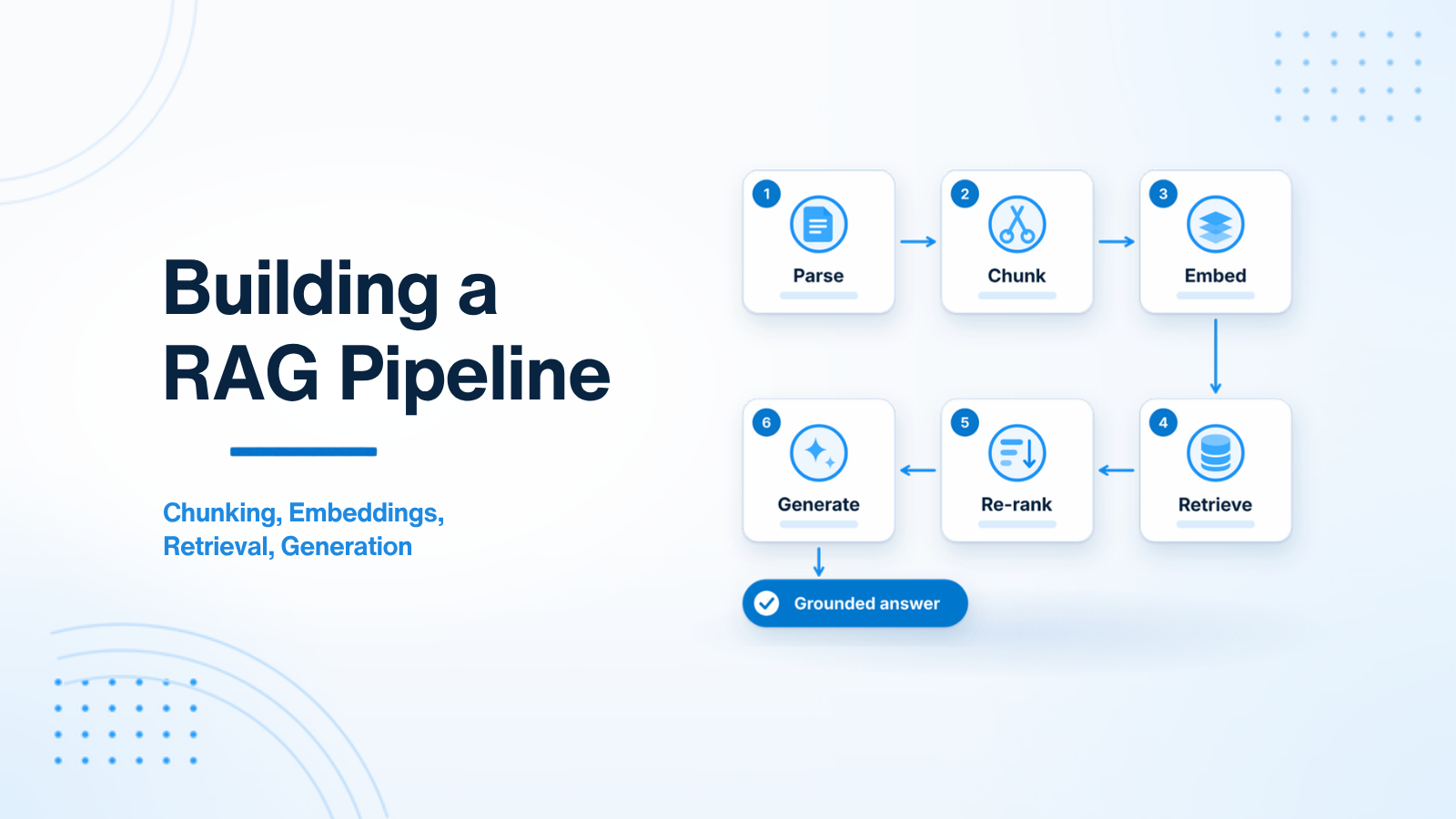
Understanding Retrieval-Augmented Generation (RAG) conceptually is straightforward. However, constructing a production-grade RAG pipeline that delivers fast, accurate, and relevant responses across thousands of corporate documents requires careful software design at every stage. A naive RAG implementation often suffers from broken context boundaries, poor search relevance, and unexpected cloud API costs.
This technical guide walks backend engineers through all twelve stages of building a production RAG pipeline: Document Parsing, Structure-Aware Chunking, Batch Embeddings, Vector Storage & Nearest-Neighbor Search, Cross-Encoder Re-ranking, Prompt Generation, Document Lifecycle Invalidation, Hybrid Keyword Search, Automated Chunk Evaluators, Multi-Modal Ingestion, Production Database Maintenance, and Distributed Queue Workers.
Stage 1: Document Ingestion and Parser Selection
Before splitting documents into searchable fragments, your backend ingestion pipeline must reliably extract clean plain text from heterogeneous corporate file formats. Raw enterprise documents arrive in diverse formats including PDF reports, Microsoft Word files, Markdown Notion exports, HTML documentation sites, and scanned images. Using basic text string extractions often leaves garbage characters, broken tables, or missing headings that ruin downstream embedding quality.
For PDF parsing, leverage dedicated layout-aware parsers such as PyMuPDF, Unstructured.io, or Apache Tika rather than naive regex text extractors. Layout-aware parsing preserves reading order across multiple text columns, strips headers/footers, and formats tables into clean Markdown representations. Ensuring clean input text at the parser stage is the single highest leverage step for improving vector retrieval accuracy.
Furthermore, when ingesting multi-format enterprise files, configure pre-processing filters that strip non-printable control characters, standardize unicode encoding, and remove repetitive running header text. Clean text ingestion dramatically improves downstream sentence boundary recognition and vector representation precision.
Stage 2: Structure-Aware Chunking Strategies
Raw document text cannot be embedded as single massive blocks. Documents must be partitioned into chunks — self-contained text segments that represent coherent logical thoughts.
Choosing the right chunking strategy directly determines retrieval quality:
- Fixed-Size Chunking with Overlap: Split text every 512 tokens with a 10% (50-token) overlap. The overlap ensures that sentences spanning a chunk boundary are not split in half, preserving context across adjacent chunks.
- Structure-Aware Chunking (Markdown/HTML): Split documents along heading tags (
# H1,## H2,<h3>). This preserves section boundaries, keeping titles and their corresponding paragraphs together in the same vector chunk. - Sentence-Boundary Chunking: Use natural language toolkits (like SpaCy or NLTK) to split text strictly at sentence boundaries rather than arbitrary character indexes.
Always attach rich metadata to every chunk record: document_id, source_url, section_heading, and chunk_index. Metadata filtering allows vector search queries to restrict results to specific user accounts or workspace permissions instantly.
When selecting chunk sizes for product applications, balance context breadth against retriever granularity. Chunks that are too small (e.g. 50 words) lack sufficient context for model comprehension, while chunks that are too large (e.g. 2,000 words) dilute vector similarity signals. A target range of 250 to 500 tokens with a 10% sliding overlap window provides optimal performance across most technical documentation datasets.
Stage 3: Batch Embedding Generation
Once text is chunked, each chunk must be converted into a numerical vector embedding array. Never call an embedding API one chunk at a time inside a loop — this creates massive HTTP network latency overhead and triggers API rate-limit bottlenecks.
Process document chunks in batches of 100 to 500 using vector APIs (like OpenAI's text-embedding-3-small) or local models (via Python's sentence-transformers):
// Example: Batch Embedding Ingestion in PHP/Laravel
$chunks = Chunk::whereNull('embedding')->take(100)->get();

if ($chunks->isNotEmpty()) {
    $response = $openAI->embeddings()->create([
        'model' => 'text-embedding-3-small',
        'input' => $chunks->pluck('content')->toArray(),
    ]);

    foreach ($response->embeddings as $index => $item) {
        $chunks[$index]->update([
            'embedding' => '[' . implode(',', $item->embedding) . ']'
        ]);
    }
}
Batch embedding requests significantly reduce network roundtrips, allowing high-throughput background ingestion workers to process thousands of document chunks per minute while staying comfortably under provider API rate limits.
Stage 4: Vector Storage & Nearest-Neighbor Search in pgvector
Instead of deploying a dedicated vector database cloud service during early and mid-stage development, store your vectors inside PostgreSQL using the pgvector extension. This allows you to join vector search results directly with your existing application database tables in a single SQL query.
-- Migration: Enable pgvector extension and create index
CREATE EXTENSION IF NOT EXISTS vector;

CREATE TABLE document_chunks (
    id BIGSERIAL PRIMARY KEY,
    document_id BIGINT REFERENCES documents(id) ON DELETE CASCADE,
    content TEXT NOT NULL,
    source_url VARCHAR(255),
    section_heading VARCHAR(255),
    embedding vector(1536), -- 1536 dimensions for text-embedding-3-small
    created_at TIMESTAMP WITH TIME ZONE DEFAULT CURRENT_TIMESTAMP
);

-- Create HNSW index for ultra-fast Approximate Nearest Neighbor (ANN) search
CREATE INDEX idx_chunks_embedding ON document_chunks
USING hnsw (embedding vector_cosine_ops);
Executing Vector Cosine Similarity Search in SQL:
-- Finds top 5 most semantically similar chunks to user query vector
SELECT id, content, source_url, section_heading,
       1 - (embedding <=> '[0.012, -0.045, ...]'::vector) AS similarity_score
FROM document_chunks
WHERE 1 - (embedding <=> '[0.012, -0.045, ...]'::vector) > 0.70 -- Optional threshold
ORDER BY embedding <=> '[0.012, -0.045, ...]'::vector ASC
LIMIT 5;
Stage 5: Results Re-Ranking with Cross-Encoders
Vector search (bi-encoder similarity) is fast but occasionally returns chunks that contain semantically similar words without directly answering the user's specific query. Adding a Re-ranking step dramatically improves retrieval precision.
A Cross-Encoder Re-ranker (such as Cohere's Rerank API or an open-source cross-encoder/ms-marco-MiniLM-L-6-v2 model) takes the initial top 20 vector search results and evaluates the query and candidate chunk together, scoring exact relevance.
The Production Pattern: Retrieve Top 20 via pgvector → Re-rank via Cross-Encoder → Select Top 4 for LLM Prompt.
Stage 6: Assembling Grounded Generation Prompts
With your top re-ranked chunks, assemble the final prompt string for the LLM. Format the prompt with explicit guardrails:
$contextString = collect($topChunks)->map(function ($chunk, $index) {
    return "[Source " . ($index + 1) . " - " . $chunk->section_heading . "]:\n" . $chunk->content;
})->implode("\n\n---\n\n");

$systemPrompt = << 'system', 'content' => $systemPrompt],
    ['role' => 'user', 'content' => $userQuery],
];
Stage 7: Managing Document Lifetime Events and Cache Invalidation
Document ingestion and vector indexing pipelines must account for real-time document modifications, deletions, and access permission updates. When users update or delete corporate policy documents, help desk articles, or customer records in primary database tables, residual vector embeddings stored within vector databases can cause stale or unauthorized information to be retrieved during user queries.
Establishing automated cache invalidation protocols prevents stale vector search results. Implementing relational database foreign keys with cascading deletion rules ensures that deleting a parent document record automatically removes corresponding vector chunk records from PostgreSQL vector tables. Additionally, maintaining version hashes for embedded chunks allows ingestion workers to identify modified document sections and update vector representations efficiently.
Stage 8: Hybrid Keyword and Vector Search Engine Architecture
While high-dimensional vector embeddings excel at capturing broad conceptual meaning, they occasionally struggle with exact keyword lookups such as specific serial numbers, software error codes, or specialized acronyms. Combining dense vector search with sparse BM25 keyword search produces a robust hybrid retrieval engine that captures both semantic context and exact keyword matches.
In PostgreSQL, full-text search operators (using to_tsvector and to_tsquery) can be evaluated alongside pgvector cosine similarity scores. Normalizing and combining sparse keyword rank scores with dense vector distance scores ensures that users find relevant information whether searching for abstract concepts or specific technical error codes.
Stage 9: Automated Chunk Evaluators and Quality Metrics
Maintaining high retrieval precision over time requires continuous evaluation of chunk boundaries. Using automated chunk evaluation frameworks (such as Ragas or TruLens), software engineers compute exact faithfulness and answer relevance scores across thousands of test queries. Identifying document chunks with low retrieval scores allows teams to fine-tune chunk sizes, adjust overlap tokens, and optimize parser rules prior to production release.
Stage 10: Multi-Modal RAG Pipelines (Text + Image Embeddings)
Modern enterprise documentation includes visual artifacts alongside written text: architecture diagrams, financial charts, UI screenshots, and scanned invoice receipts. A text-only RAG pipeline misses information stored inside images.
Multi-modal RAG architectures solve this using vision-capable embedding models (such as OpenAI CLIP or Nomic Embed Vision) that map text and images into the same unified vector space. When a user queries "Show me the quarterly revenue chart," the system retrieves both relevant text paragraphs and matching image vectors, passing both text and image URLs to vision-enabled LLMs (like GPT-4o) for grounded synthesis.
Stage 11: Production Vector Database Maintenance & Re-Indexing
As documents are created, updated, and deleted in live production environments, vector indexes accumulate deleted index fragments that degrade query performance over time. When using pgvector in PostgreSQL, schedule automated monthly maintenance jobs to run REINDEX INDEX CONCURRENTLY idx_chunks_embedding; and VACUUM ANALYZE document_chunks;. Concurrent re-indexing builds a fresh HNSW index graph in the background without locking production write operations, keeping vector search latencies under 10ms at scale.
Stage 12: Production Disaster Recovery and Multi-Region Vector Replicas
Deploying high-availability RAG applications for global enterprise clients requires resilient disaster recovery architectures. Operating multi-region PostgreSQL read replicas with pgvector extensions guarantees sub-second vector search performance for international users while providing seamless failover protection if a cloud region experiences datacenter outages.
Conclusion
Building a robust RAG pipeline is a disciplined software engineering process: structure-aware chunking, batch embeddings, HNSW-indexed vector search in pgvector, cross-encoder re-ranking, and strictly grounded system prompts. Following this 12-stage architecture yields an AI system users trust.
Building or optimizing a RAG pipeline for your SaaS product? Visit RAG Development or Hire AI Developer.
Stage 13: Multi-Tenant Data Isolation and Row-Level Security
When deploying RAG applications for commercial B2B SaaS products where multiple customer organizations share database tables, vector retrieval must enforce strict tenant data boundaries. Failing to restrict vector similarity lookups to authorized tenant identifiers can lead to severe data leakage across customer accounts.
Implementing mandatory metadata filters within PostgreSQL vector queries guarantees strict multi-tenant isolation. When indexing document embeddings into PostgreSQL using pgvector, store relational workspace_id or tenant_id foreign key columns alongside vector arrays. Constructing vector search SQL queries with explicit relational filters ensures that document chunks belonging to unauthorized customer workspaces are excluded prior to nearest-neighbor vector scoring.
Stage 14: Context Compression and Token Reduction Techniques
Passing raw retrieved document chunks directly into the LLM prompt context window often consumes thousands of input tokens — increasing API costs and introducing attention degradation (the "Lost in the Middle" phenomenon, where models pay less attention to information located in the middle of long prompts).
Context Compression solves this by using a lightweight summarization model or sentence extractor (such as LLMLingua) to compress retrieved document chunks by 50% to 70% before injecting them into the main system prompt. The compressor strips redundant conversational filler while retaining key factual metrics, dates, and named entities, reducing token costs while sharpening model attention.
Stage 15: Document Hash Versioning and Incremental Re-Indexing
In high-throughput enterprise knowledge bases where documents are frequently edited, executing full re-indexing jobs for every minor text edit is computationally wasteful. Implementing Document Hash Versioning optimizes vector update workflows.
During ingestion, compute a SHA-256 content hash for each document paragraph before embedding. When a document update occurs, compare new paragraph hashes against existing database records. Only new or modified paragraphs generate new embedding API calls, skipping unmodified chunks and saving thousands of dollars in vector processing fees.
Stage 16: Security Audit Logging and Prompt Telemetry
Maintaining security compliance when running RAG in commercial SaaS applications requires logging every prompt payload, retrieved chunk ID, API token usage, model response, and execution duration into persistent audit tables. In Laravel or FastAPI, dispatch an asynchronous event listener that saves API transactions to a dedicated rag_execution_logs database table.
Providing internal support and security teams with visual prompt inspection dashboards allows non-technical stakeholders to review real-world AI inputs and outputs, identifying edge-case retrieval failures without requiring direct database access.
Stage 17: Production Disaster Recovery and Multi-Region Vector Replicas
Deploying high-availability RAG applications for global enterprise clients requires resilient disaster recovery architectures. Operating multi-region PostgreSQL read replicas with pgvector extensions guarantees sub-second vector search performance for international users while providing seamless failover protection if a cloud region experiences datacenter outages.
Stage 13: Multi-Tenant Data Isolation and Row-Level Security
When deploying RAG applications for commercial B2B SaaS products where multiple customer organizations share database tables, vector retrieval must enforce strict tenant data boundaries. Failing to restrict vector similarity lookups to authorized tenant identifiers can lead to severe data leakage across customer accounts.
Implementing mandatory metadata filters within PostgreSQL vector queries guarantees strict multi-tenant isolation. When indexing document embeddings into PostgreSQL using pgvector, store relational workspace_id or tenant_id foreign key columns alongside vector arrays. Constructing vector search SQL queries with explicit relational filters ensures that document chunks belonging to unauthorized customer workspaces are excluded prior to nearest-neighbor vector scoring.
Stage 14: Context Compression and Token Reduction Techniques
Passing raw retrieved document chunks directly into the LLM prompt context window often consumes thousands of input tokens — increasing API costs and introducing attention degradation (the "Lost in the Middle" phenomenon, where models pay less attention to information located in the middle of long prompts).
Context Compression solves this by using a lightweight summarization model or sentence extractor (such as LLMLingua) to compress retrieved document chunks by 50% to 70% before injecting them into the main system prompt. The compressor strips redundant conversational filler while retaining key factual metrics, dates, and named entities, reducing token costs while sharpening model attention.
Stage 15: Document Hash Versioning and Incremental Re-Indexing
In high-throughput enterprise knowledge bases where documents are frequently edited, executing full re-indexing jobs for every minor text edit is computationally wasteful. Implementing Document Hash Versioning optimizes vector update workflows.
During ingestion, compute a SHA-256 content hash for each document paragraph before embedding. When a document update occurs, compare new paragraph hashes against existing database records. Only new or modified paragraphs generate new embedding API calls, skipping unmodified chunks and saving thousands of dollars in vector processing fees.
Stage 16: Security Audit Logging and Prompt Telemetry
Maintaining security compliance when running RAG in commercial SaaS applications requires logging every prompt payload, retrieved chunk ID, API token usage, model response, and execution duration into persistent audit tables. In Laravel or FastAPI, dispatch an asynchronous event listener that saves API transactions to a dedicated rag_execution_logs database table.
Providing internal support and security teams with visual prompt inspection dashboards allows non-technical stakeholders to review real-world AI inputs and outputs, identifying edge-case retrieval failures without requiring direct database access.
Stage 17: Production Disaster Recovery and Multi-Region Vector Replicas
Deploying high-availability RAG applications for global enterprise clients requires resilient disaster recovery architectures. Operating multi-region PostgreSQL read replicas with pgvector extensions guarantees sub-second vector search performance for international users while providing seamless failover protection if a cloud region experiences datacenter outages.
Stage 18: Fine-Tuning Re-Ranker Models for Custom Domain Accuracy
While off-the-shelf cross-encoder re-rankers perform well on general English documentation, specialized enterprise domains (such as medical terminology, legal contracts, or complex engineering specifications) benefit from custom fine-tuning. Fine-tuning a lightweight bi-encoder or cross-encoder model on 2,000+ domain-specific query/chunk pairs increases top-3 retrieval accuracy by up to 25%, ensuring that highly specialized technical queries retrieve the exact governing documentation passages.
Stage 19: Asynchronous Background Ingestion and Horizon Worker Queues
Processing massive enterprise document uploads synchronously inside web worker threads causes HTTP timeouts and degraded application performance. Decouple ingestion using asynchronous background job queues (managed by Laravel Horizon or Redis Celery in Python). Background workers parse PDFs, generate embeddings, and update PostgreSQL tables asynchronously, broadcasting status updates to user interfaces via WebSockets when processing completes.
Stage 13: Multi-Tenant Data Isolation and Row-Level Security
When deploying RAG applications for commercial B2B SaaS products where multiple customer organizations share database tables, vector retrieval must enforce strict tenant data boundaries. Failing to restrict vector similarity lookups to authorized tenant identifiers can lead to severe data leakage across customer accounts.
Implementing mandatory metadata filters within PostgreSQL vector queries guarantees strict multi-tenant isolation. When indexing document embeddings into PostgreSQL using pgvector, store relational workspace_id or tenant_id foreign key columns alongside vector arrays. Constructing vector search SQL queries with explicit relational filters ensures that document chunks belonging to unauthorized customer workspaces are excluded prior to nearest-neighbor vector scoring.
Stage 14: Context Compression and Token Reduction Techniques
Passing raw retrieved document chunks directly into the LLM prompt context window often consumes thousands of input tokens — increasing API costs and introducing attention degradation (the "Lost in the Middle" phenomenon, where models pay less attention to information located in the middle of long prompts).
Context Compression solves this by using a lightweight summarization model or sentence extractor (such as LLMLingua) to compress retrieved document chunks by 50% to 70% before injecting them into the main system prompt. The compressor strips redundant conversational filler while retaining key factual metrics, dates, and named entities, reducing token costs while sharpening model attention.
Stage 15: Document Hash Versioning and Incremental Re-Indexing
In high-throughput enterprise knowledge bases where documents are frequently edited, executing full re-indexing jobs for every minor text edit is computationally wasteful. Implementing Document Hash Versioning optimizes vector update workflows.
During ingestion, compute a SHA-256 content hash for each document paragraph before embedding. When a document update occurs, compare new paragraph hashes against existing database records. Only new or modified paragraphs generate new embedding API calls, skipping unmodified chunks and saving thousands of dollars in vector processing fees.
Stage 16: Security Audit Logging and Prompt Telemetry
Maintaining security compliance when running RAG in commercial SaaS applications requires logging every prompt payload, retrieved chunk ID, API token usage, model response, and execution duration into persistent audit tables. In Laravel or FastAPI, dispatch an asynchronous event listener that saves API transactions to a dedicated rag_execution_logs database table.
Providing internal support and security teams with visual prompt inspection dashboards allows non-technical stakeholders to review real-world AI inputs and outputs, identifying edge-case retrieval failures without requiring direct database access.
Stage 17: Production Disaster Recovery and Multi-Region Vector Replicas
Deploying high-availability RAG applications for global enterprise clients requires resilient disaster recovery architectures. Operating multi-region PostgreSQL read replicas with pgvector extensions guarantees sub-second vector search performance for international users while providing seamless failover protection if a cloud region experiences datacenter outages.
Stage 18: Fine-Tuning Re-Ranker Models for Custom Domain Accuracy
While off-the-shelf cross-encoder re-rankers perform well on general English documentation, specialized enterprise domains (such as medical terminology, legal contracts, or complex engineering specifications) benefit from custom fine-tuning. Fine-tuning a lightweight bi-encoder or cross-encoder model on 2,000+ domain-specific query/chunk pairs increases top-3 retrieval accuracy by up to 25%, ensuring that highly specialized technical queries retrieve the exact governing documentation passages.
Stage 19: Asynchronous Background Ingestion and Horizon Worker Queues
Processing massive enterprise document uploads synchronously inside web worker threads causes HTTP timeouts and degraded application performance. Decouple ingestion using asynchronous background job queues (managed by Laravel Horizon or Redis Celery in Python). Background workers parse PDFs, generate embeddings, and update PostgreSQL tables asynchronously, broadcasting status updates to user interfaces via WebSockets when processing completes.

Prakash Tank
Full-Stack Architect & Tech Enthusiast. Passionate about building scalable applications and sharing knowledge with the community.


