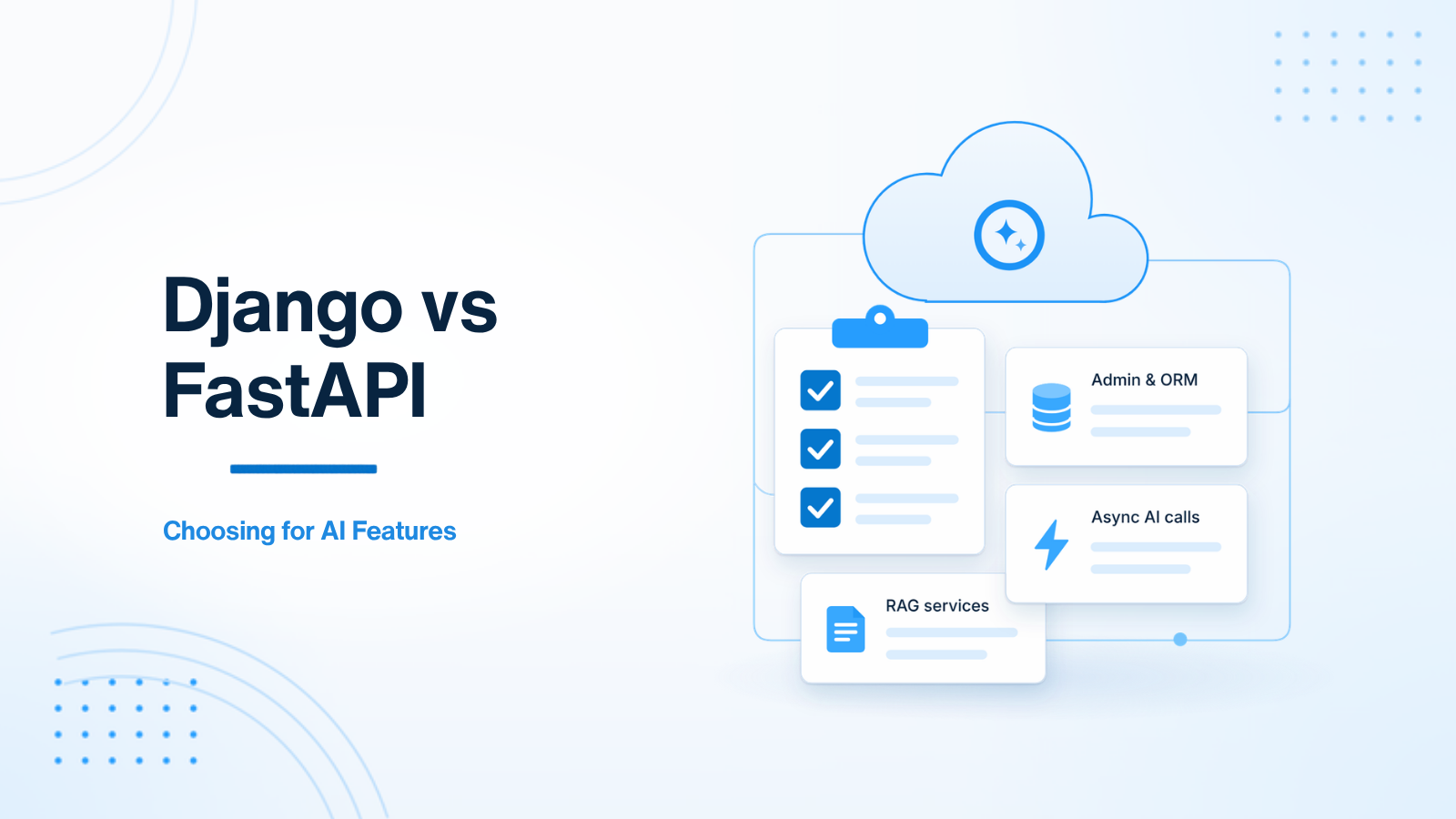
Teams adding AI to a Python product often ask the wrong first question: “Which framework is better?” The better question is what kind of product surface you are shipping. Django and FastAPI can both call an LLM. They differ in what else they optimize for: an admin-heavy SaaS versus a focused async AI service.
This is not a general FastAPI-versus-Django framework shootout. It is a decision guide for AI features: review queues, RAG, streaming chat, and hybrid setups next to an existing product API.
What Django optimizes for
Django wins when operators need a real console. If the AI feature sits beside CRM records, document uploads, review queues, and staff approvals, Django’s admin, ORM, and auth conventions reduce glue work. Django REST Framework can still expose APIs to a React or mobile client.
That matters when the AI output is not the whole product. A summarizer, a classifier, or an extraction step often needs a person to review low-confidence results, correct a field, or approve something before it reaches a customer. Django is strong at those staff workflows. You can model the record, show it in admin, and attach a permission and an audit trail without first inventing an internal app.
Django is weaker as a pure streaming LLM gateway. You can stream from Django, but FastAPI’s async-first request model and OpenAPI-first style usually feel cleaner for chat backends and high-concurrency model calls. If the service’s main job is to hold many open connections and forward tokens, Django is probably not the center of that design.
What FastAPI optimizes for
FastAPI wins for AI microservices: typed request models, automatic OpenAPI docs, async endpoints, and streaming responses for chat UIs. It is a natural home for RAG workers, embedding jobs, and tool-calling agents that sit beside a Django, Laravel, or Node product API.
The same qualities help when the AI work is bursty or slow. FastAPI pairs well with a queue and a worker: the API accepts a job, a worker calls the model, and the product gets a webhook or a status poll. You can also keep the request path async when you are calling an official async provider SDK.
FastAPI is weaker when you need a batteries-included admin for non-engineers. You can build custom admin UIs, but Django gets you there faster for internal ops tools. If your first AI feature is “staff must review these outputs every day,” starting in a framework with no admin story often delays the part users will actually touch.
Decision guide for AI features
- Choose Django when AI is one feature inside an admin-heavy Python SaaS, and staff will review outputs in Django admin or in desks backed by DRF.
- Choose FastAPI when AI is a dedicated service: RAG over documents, streaming chat, OCR pipelines, or an agent worker.
- Choose hybrid when Django, Laravel, or Node already owns the product domain, and FastAPI should own the AI workers. Share data and auth boundaries carefully.
The hybrid path is the one many production systems end up with, even if they start on one side. AI changes faster than billing and tenancy. Isolating the model layer makes it easier to change prompts, models, and pipelines without destabilizing the rest of the product.
A hybrid shape that usually works
Client / Admin UI
   |
   v
Product API (Django, Laravel, or Node): auth, billing, domain
   |
   v
FastAPI AI service: RAG, LLM calls, agents, OCR
   |
   v
Postgres + vector storage + Redis + object storage
The product API remains the source of truth for users, plans, and permissions. The FastAPI service receives only the work it needs, often a job payload or a signed request, and returns structured results. Both sides can share Postgres or object storage, but the AI service should not become a second place to change billing state.
This split also helps operations. Staff can keep using Django admin or the existing product console to review results. The FastAPI service can scale on its own when embedding or OCR load grows, without scaling the whole monolith with it.
Common mistakes
Stuffing every LLM call into a Django view, with no queue, creates timeouts as soon as a provider is slow. Building FastAPI without any admin story forces operators into SQL or a forgotten script. Claiming one framework is always “the AI framework” ignores the product shape. And copying the entire user table into the AI service, just to avoid an auth boundary, usually creates a worse problem than the one it was meant to solve.
Framework choice should follow workflow ownership. If people need to review, approve, and correct, make sure that workflow has a home. If machines need to stream, batch, and retry, make sure that work has a home. Those homes are often not the same process.
If you are starting from zero and the first release is a staff-reviewed AI feature inside a new SaaS, Django is a reasonable default. If you are starting from zero and the first release is a streaming or RAG service that other apps will call, FastAPI is a reasonable default. If you already have a product API, add FastAPI beside it rather than rewriting the product to chase a trend.
Summary
Django is a strong choice for SaaS and admin-centered products that include AI features. FastAPI is a strong choice for AI services and streaming APIs. Many production systems use both: the product backend in Django or Laravel, and an AI sidecar in FastAPI. Pick based on the surface you are shipping, not on which name appears more often in AI tutorials.
If you are choosing between Django and FastAPI for an AI feature, or you want to split a product API from an AI service, get in touch.

Prakash Tank
Full-Stack Architect & Tech Enthusiast. Passionate about building scalable applications and sharing knowledge with the community.