Choosing a Python framework for a product is less about which name is more popular, and more about what you need to ship in the first year. Django and FastAPI are the two options most teams argue between. They overlap, but they start from different assumptions.
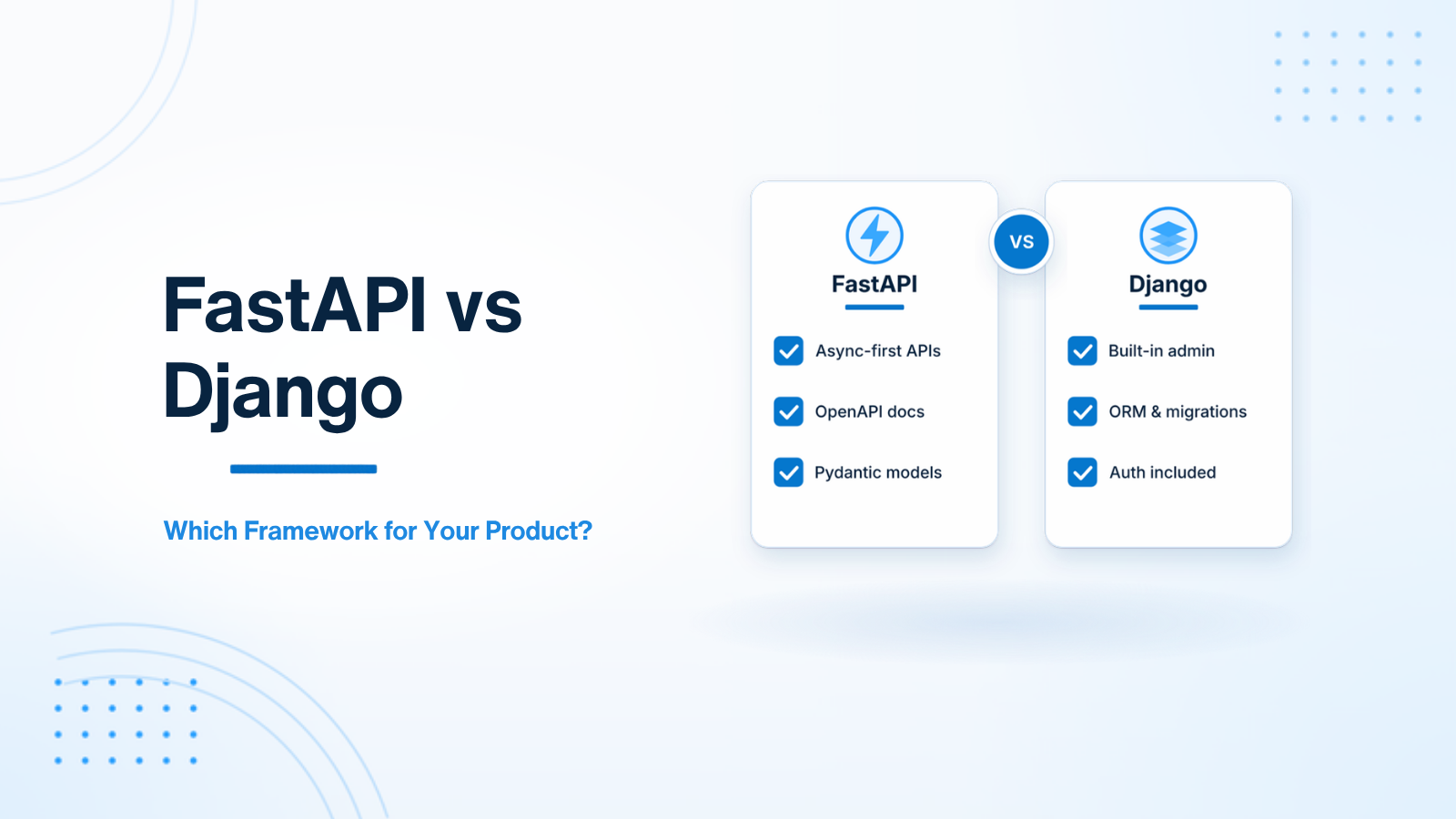
Django is a full product framework. It ships an ORM, migrations, authentication, an admin site, and a template engine, and it can also expose a JSON API through Django REST Framework. FastAPI is an API framework. It gives you typed request and response models, async routes, and OpenAPI documentation, and you add a database, migrations, and any staff UI yourself.
This article is about that product fit: admin, data, auth, async work, and how much you want to assemble. It is not a benchmark, and it does not invent a winner for every product. A narrower question — where AI features should live — is a separate decision.
What you are actually choosing
Django assumes you may need a lot of product infrastructure in one place. That is why it is often used as a monolith. It does not have to stay that way, but the framework is comfortable when one project owns users, records, an admin, and a set of pages or an API.
FastAPI assumes the HTTP layer should stay small. You pick SQLAlchemy, SQLModel, or another data layer, Alembic for migrations, and whatever auth scheme you need. That is a better starting point when the product is an API for a separate frontend or for other services, and a slower start when non-engineers need a console on day one.
The two can look similar in a single route. The difference shows up in everything around that route.
# Django REST Framework
class ItemSerializer(serializers.ModelSerializer):
    class Meta:
        model = Item
        fields = ("id", "title")


class ItemViewSet(viewsets.ReadOnlyModelViewSet):
    queryset = Item.objects.all()
    serializer_class = ItemSerializer
# FastAPI
@router.get("/items/{item_id}", response_model=ItemResponse)
async def get_item(
    item_id: int,
    session: AsyncSession = Depends(get_session),
):
    item = await session.get(Item, item_id)
    if item is None:
        raise HTTPException(status_code=404, detail="Item not found")
    return item
Neither snippet is a complete app. The Django side already assumes a model, a router, and DRF’s conventions. The FastAPI side assumes you have wired a session dependency, a Pydantic response model, and a database of your choosing.
A fair comparison
| Area | Django | FastAPI |
|---|---|---|
| Starting shape | A product framework with a lot included | A focused API layer; you add the rest |
| Admin | Django Admin is included | No official admin; you build one or use another app |
| Data and migrations | Django ORM and built-in migrations | Bring your own, commonly SQLAlchemy 2.0 or SQLModel, plus Alembic |
| Auth | Users, permissions, and session auth are included | You choose a scheme and libraries (OAuth2, JWT, and so on) |
| Validation | Forms, model validation, and DRF serializers | Pydantic v2 models from type hints |
| API documentation | Add a package such as drf-spectacular | OpenAPI and Swagger UI from the same code |
| Async | ASGI and async views are supported; much of the stack is still used synchronously | Async-first, which is a natural fit for streaming and high-concurrency I/O |
| HTML UI | Template engine is part of the default toolkit | Can serve templates, but is usually an API behind a separate frontend |
Performance is the row that is easiest to overstate. FastAPI is thinner and was designed around ASGI. Django also runs on ASGI, but a typical request often passes through more built-in middleware and ORM behaviour. For many CRUD products, that difference is not the reason to choose. If you have a measured bottleneck, fix that bottleneck. Do not switch frameworks on a slogan.
When Django is the better default
Pick Django when the product needs a staff-facing console early: support, operations, or content people editing records. Django Admin is not the only UI you will ever have, but it is a real one on day one, with permissions you did not have to invent.
It is also a strong default when you want authentication, migrations, and models in the same project, and when some of the product will be server-rendered pages. A “SaaS monolith” is the common shape, not a requirement. You can still expose a public API with Django REST Framework and put a React or mobile client in front of it.
If the team already ships Django confidently, that matters more than a theoretical architecture diagram. A product that ships with ordinary tools usually beats a rewrite to a stack nobody on the team has operated.
When FastAPI is the better default
Pick FastAPI when the product is an API first: a separate frontend, a mobile client, or other services will call it, and you do not need a built-in admin to start. The type-hinted models and generated OpenAPI docs are part of how you work with those clients, not an add-on.
It is also a better starting point when async I/O is in the core loop: streaming responses, many open connections, or calling other HTTP APIs without blocking a worker for every wait. FastAPI does not make CPU-bound work faster by itself. It does make the async path straightforward.
Teams that already think in SQLAlchemy, or that want the HTTP layer to stay small and explicit, will usually be happier here than in a framework that brings a more complete product stack they do not plan to use.
When using both is reasonable
You do not have to pick only one for the whole company. A common shape is Django for the product, the admin, and ordinary CRUD, and a FastAPI service for a specific async or isolated workload, such as a streaming endpoint or a worker-facing API. That split has a cost: two deployments, two auth boundaries, and more operational surface.
Use a hybrid when a second service has a clear job. Do not split a young product just to have both names in the architecture. One well-run codebase is easier to operate than two half-finished ones.
Questions that actually decide it
- Who needs to edit data besides engineers, and how soon?
- Is the first user interface a Django template, a separate frontend, or both?
- How much of the core product loop is async I/O or streaming?
- Which framework can this team already ship and operate with confidence?
If staff need a console immediately, Django is usually the shorter path. If you are building an API with a separate UI and a lot of I/O waits, FastAPI is usually the shorter path. If the answers are mixed, start with the side that covers the first release, and add a second service only when a job actually needs it.
What not to do
- Do not rewrite a working Django product in FastAPI for “performance” without a measured problem.
- Do not choose FastAPI and then be surprised that you need to build an admin, auth, and migrations.
- Do not treat async as automatically faster for CPU-bound work.
- Do not force one framework to do a job the other already covers well in the same organisation, if a small second service would be clearer.
Summary
Django is the better default when you want product infrastructure included: admin, auth, an ORM, and migrations, often in a single application. FastAPI is the better default when you want a small, typed, async API and are ready to choose the rest of the stack. The useful comparison is that fit, not a generic claim about speed or popularity. If the product later needs both shapes, you can introduce a second service once the boundary is real.
If you want help choosing between FastAPI and Django for a product, or splitting work between them, get in touch.

Prakash Tank
Full-Stack Architect & Tech Enthusiast. Passionate about building scalable applications and sharing knowledge with the community.