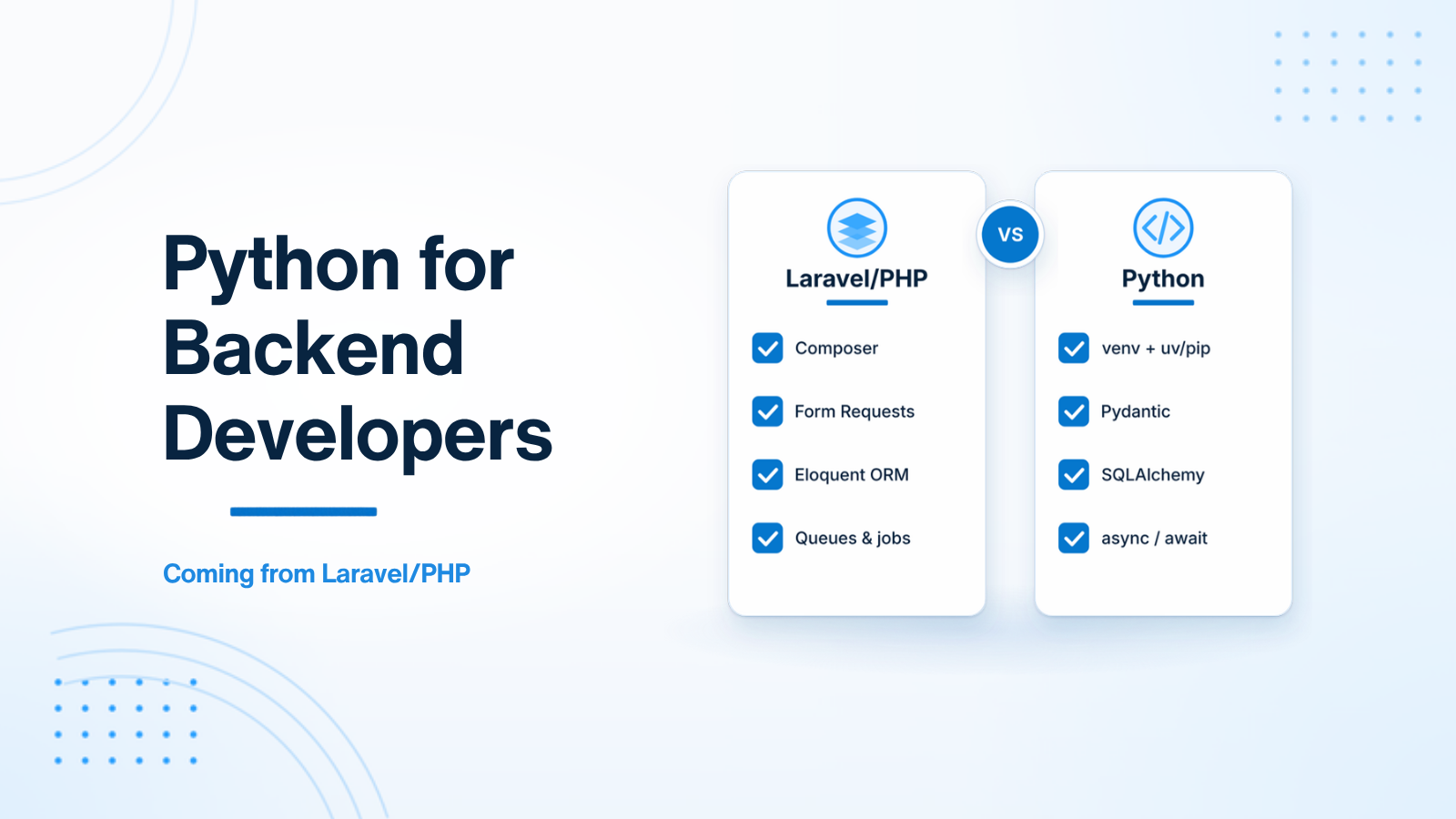
If you are an experienced PHP developer — especially one accustomed to the elegance, conventions, and ecosystem of Laravel — stepping into Python for backend development can feel both refreshingly simple and confusingly unstructured. Laravel gives you a batteries-included ecosystem out of the box: Eloquent, Artisan, Blade, Queue workers, and predefined directory layouts. Python, by contrast, gives you a versatile language and a rich library ecosystem, leaving framework and architecture choices largely up to you.
This guide is designed specifically for PHP and Laravel engineers looking to adopt Python for backend services, microservices, and AI backend development without unlearning solid software engineering practices.
Mental Model Shift: Monolith Framework vs Modular Ecosystem
In Laravel, almost everything you need is built into the framework or provided by first-party packages (Cashier, Scout, Horizon, Sanctum). In Python, backend development is built by composing specialized, decoupled libraries.
| Laravel Concept | Python Equivalent | Notes |
|---|---|---|
Composer (composer.json) | pip, Poetry, or uv (pyproject.toml) | Dependency management and package publishing |
| Eloquent ORM | SQLAlchemy, SQLModel, or Tortoise ORM | Data mapping & DB interactions |
| Laravel Artisan CLI | Click, Typer, or custom scripts | CLI tool creation |
| Laravel Queues & Horizon | Celery, RQ, or Redis Streams | Asynchronous background processing |
| Laravel Service Container / DI | FastAPI Dependencies, Dependency Injector | Dependency Injection & IoC |
| Laravel Validation Rules | Pydantic schemas | Strict data parsing and validation |
1. Environments & Package Management
In PHP, Composer installs packages into a local vendor/ directory in the root of your project. In Python, installing packages globally with plain pip install corrupts your system environment. Python uses virtual environments (venv) to isolate dependencies per project.
Modern Python projects use tools like Poetry or uv to manage virtual environments and dependencies declaratively in a single file called pyproject.toml.
# Setting up a new Python project with Poetry
poetry new my-backend-service
cd my-backend-service
poetry add fastapi uvicorn pydantic sqlalchemy
This creates a isolated virtualenv automatically and locks dependencies, just like composer.lock does for PHP.
2. Type Hints and Data Validation: Eloquent vs Pydantic
In Laravel, request validation is typically handled via Form Requests or inline $request->validate([...]). In Python, modern frameworks like FastAPI use Pydantic for data validation and serialization. Pydantic leverages Python type hints to enforce data schemas at runtime.
Laravel Form Request:
public function rules(): array
{
    return [
        'email' => 'required|email',
        'age'   => 'required|integer|min:18',
    ];
}
Python Pydantic Schema:
from pydantic import BaseModel, EmailStr, Field

class UserCreateRequest(BaseModel):
    email: EmailStr
    age: int = Field(ge=18)

# Automatic validation on instantiation
user_data = UserCreateRequest(email="dev@example.com", age=25)
If invalid data is passed, Pydantic immediately raises a detailed validation error with line numbers and field names, which FastAPI automatically converts into structured 422 HTTP responses.
3. Database Layer: Eloquent vs SQLAlchemy
Laravel's Eloquent uses the Active Record pattern — your database models inherit methods like User::create() or $user->save() directly. Python's primary ORM, SQLAlchemy, uses the Data Mapper pattern, separating data models from database session management.
from sqlalchemy import Column, Integer, String
from sqlalchemy.orm import declarative_base, Session

Base = declarative_base()

class User(Base):
    __tablename__ = "users"

    id = Column(Integer, primary_key=True, index=True)
    email = Column(String, unique=True, index=True)
    name = Column(String)

# Saving a user requires an explicit session transaction
def create_user(db: Session, email: str, name: str):
    user = User(email=email, name=name)
    db.add(user)
    db.commit()
    db.refresh(user)
    return user
4. Asynchronous I/O and Concurrency
PHP traditionally runs as a synchronous, shared-nothing architecture (FPM handles one request per worker process). Python natively supports asynchronous I/O with async and await syntax.
In FastAPI, an async endpoint can handle thousands of concurrent requests while waiting for external network I/O (like calling OpenAI API or a third-party payment gateway) without blocking the process thread:
@app.get("/ai-summary")
async def get_summary(prompt: str):
    # Non-blocking async API call
    response = await async_openai_client.chat.completions.create(
        model="gpt-4o",
        messages=[{"role": "user", "content": prompt}]
    )
    return {"summary": response.choices[0].message.content}
Conclusion
Moving from Laravel to Python is not about abandoning your backend principles — it is about applying clean architecture, solid OOP design, and type safety within Python's high-performance async ecosystem. If you are building standalone AI services, microservices, or data processing backends, combining Laravel for user management with Python FastAPI for AI workloads provides the ultimate hybrid architecture.
Need help integrating Python AI services with your Laravel application? Visit Python AI Development or Hire AI Developer.

Prakash Tank
Full-Stack Architect & Tech Enthusiast. Passionate about building scalable applications and sharing knowledge with the community.