If your product engineering team has spent any time adding AI features into a commercial SaaS application, you have encountered the hallucination problem. You ask a large language model a question regarding your company's proprietary product documentation, customer account history, or internal security policies — and the model confidently returns an answer that sounds completely convincing but is entirely incorrect.
Retrieval-Augmented Generation (RAG) is the industry-standard software architecture for solving this problem in production AI applications. This comprehensive guide explains what RAG is, why fine-tuning is not a substitute for RAG, how vector search works, and how to determine if your SaaS product requires a RAG pipeline.
1. The Root Cause: Why LLMs Hallucinate
Large Language Models (like GPT-4o, Claude Sonnet, or Llama 3) are trained on vast snapshots of public internet data up to a specific cutoff date. A language model is fundamentally a statistical pattern predictor — it predicts the next most probable token based on its training parameters. It does not possess a real-time database lookup mechanism.
Consequently, LLMs know nothing about:
- Your company's private, internal help desk articles, Notion wikis, or Google Drive docs.
- Your customer's private account records, subscription tier, invoices, or order history.
- Proprietary business logic and pricing tables created after the model's training date.
- System events, customer support tickets, or database updates that occurred yesterday or an hour ago.
When asked about topics outside its training dataset, an LLM attempts to complete the text sequence based on statistical patterns — producing hallucination. Fine-tuning a model on your documents does not solve hallucination; fine-tuning teaches a model a specific writing style, output format, or tone — it does not turn the model into a reliable, searchable factual database lookup table.
2. What RAG Accomplishes
RAG solves the knowledge gap by converting the problem from a memory retrieval task into an open-book reading comprehension task. Instead of relying on the LLM's static parameters to remember facts, a RAG pipeline retrieves relevant passages from your private database at the exact moment a user asks a question, and injects those passages directly into the LLM's prompt context.
By grounding model generation in explicitly retrieved source passages, RAG eliminates the primary cause of hallucinations. If the requested information is absent from the retrieved documents, the system can instruct the model to report that no answer was found rather than inventing plausible fiction.
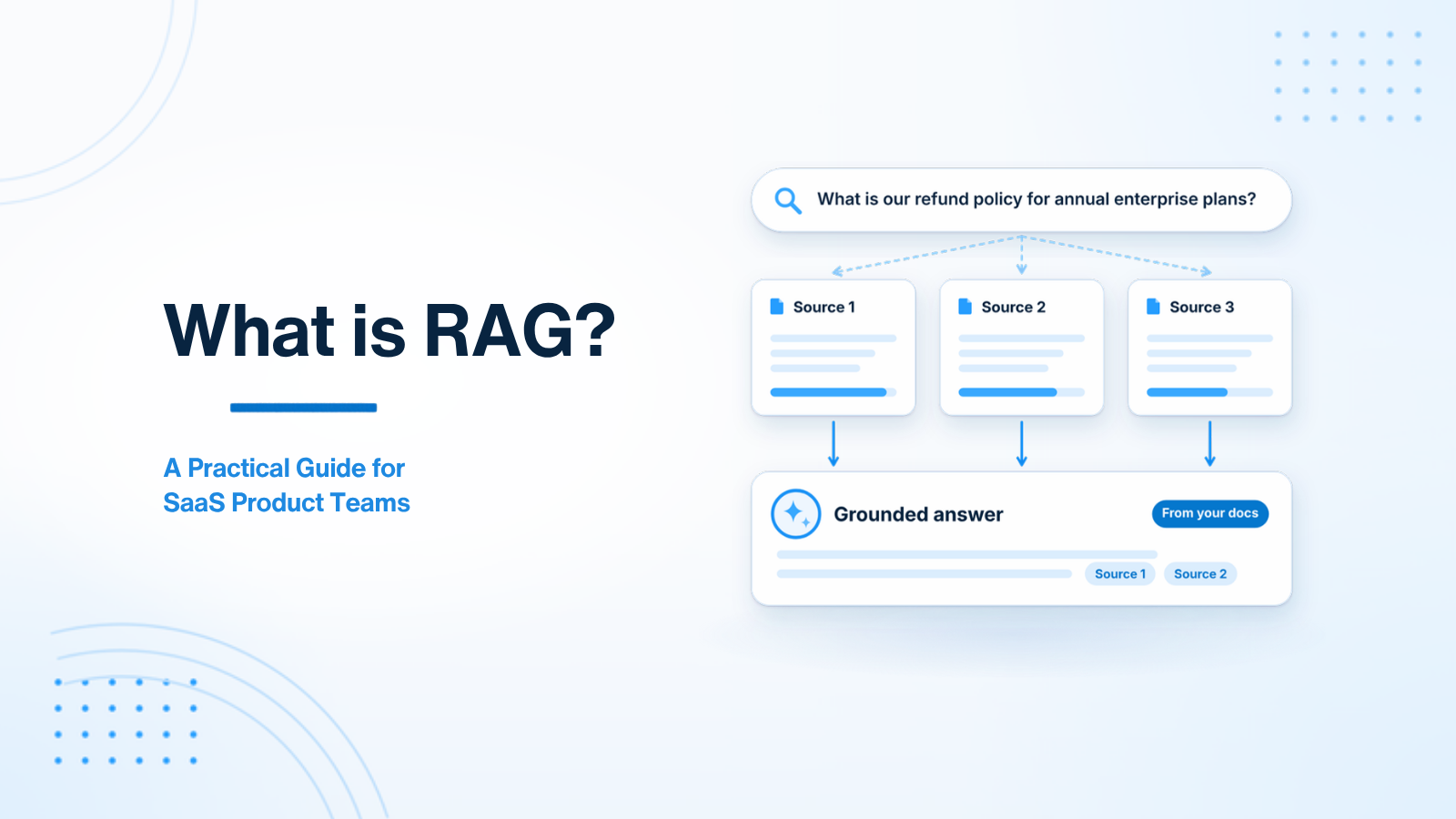
The 4-Step RAG Pipeline Execution Flow:
- User Question: A user submits a query: "What is our refund policy for annual enterprise plans?"
- Retrieval Step: Your application searches a vector database (containing embedded chunks of your policy documents) for the top 3–5 passages most semantically relevant to "refund policy annual enterprise."
- Augmented Prompt Assembly: The retrieved document passages are combined into an augmented prompt: "Answer the user's question using ONLY the provided policy context below..."
- Grounded Generation: The LLM reads the provided context and synthesizes an accurate, grounded answer with zero hallucination.
Because LLMs excel at reading comprehension and summarization, RAG leverages the model's core strengths while bypassing its memory limitations.
3. The Technical Engine: Text Embeddings and Vector Search
The core engineering challenge in RAG lies in the retrieval step: how does your system find passages that match the meaning of a user's question, even if they use completely different words?
This is accomplished using Text Embeddings. An embedding model (like OpenAI's text-embedding-3-small or open-source sentence-transformers) converts a block of text into a high-dimensional vector array (e.g., 1,536 floating-point numbers). Texts with similar semantic meanings are positioned close together in high-dimensional vector space.
// Conceptual vector similarity
Vector("refund policy")  -> [0.12, -0.45, 0.88, ...]
Vector("money back rule") -> [0.14, -0.43, 0.85, ...] (High Cosine Similarity!)
Vector("database backup") -> [-0.88, 0.05, -0.12, ...] (Low Cosine Similarity!)
These vectors are stored inside a Vector Database (pgvector in PostgreSQL, Pinecone, or Chroma). When a query arrives, you embed the query string and execute a vector similarity search (using cosine distance) to retrieve the closest matching document chunks in milliseconds.
4. Decision Framework: Do You Need RAG?
Before building a RAG infrastructure, evaluate whether your feature genuinely requires vector retrieval:
| Scenario / Feature Requirement | Need RAG Architecture? | Recommended Approach |
|---|---|---|
| Answering questions over private user documents (PDFs, Help Docs) | YES (Essential) | Full RAG Pipeline (pgvector + Embeddings) |
| Auditability & Source Citation requirements | YES (Essential) | RAG with source metadata links |
| Small dataset that fits in 128k prompt context (under 50 pages) | NO | Direct Prompt Context Injection |
| General coding, translation, or creative writing assistance | NO | Standard LLM API Prompting |
| Structured SQL database queries (e.g. "Total sales today?") | NO | Text-to-SQL or Database Tool Calling |
5. Measuring RAG Success: Key Metrics
Building a successful RAG system requires measuring performance across three critical metrics known as the RAG Triad:
Context Relevance: Measures whether the retrieved document chunks are actually relevant to the user's input query. Low context relevance indicates poor embedding models or bad chunking strategies.
Groundedness (Faithfulness): Measures whether the LLM's generated response is strictly derived from the retrieved context without introducing outside assumptions or hallucinated facts.
Answer Relevance: Measures whether the final answer directly addresses the user's original question in a helpful and concise manner.
6. Common RAG Production Pitfalls
Building a prototype RAG script takes an hour; building a production-grade RAG system requires avoiding common failure modes:
Arbitrary Chunking: Splitting text blindly at fixed character counts (e.g. every 500 characters) cuts sentences in half. Use structure-aware or paragraph-boundary chunking.
Over-Retrieval vs Under-Retrieval: Passing 20 document chunks into the prompt degrades LLM reasoning focus; passing only 1 chunk misses necessary context. 3 to 5 chunks is typically optimal.
Lack of Re-ranking: Vector similarity search finds semantically close text, but adding a Cross-Encoder Re-ranker (like Cohere Rerank) ensures the retrieved chunks are directly useful for answering the query.
Stale Vector Embeddings: When documents are deleted or updated in primary databases, vector indexes must be updated synchronously to prevent leaking outdated or deleted information to end users.
7. Data Privacy and Security Guardrails in RAG Architectures
Deploying Retrieval-Augmented Generation across enterprise software environments requires strict multi-tenant security enforcement. In multi-tenant SaaS applications where multiple customer organizations share database tables, vector search queries must enforce organizational security boundaries at the database layer. Failing to restrict vector similarity queries to authorized tenant identifier boundaries can result in sensitive document leakage across customer accounts.
Implementing mandatory metadata filtering within vector databases guarantees strict data segregation. When indexing document embeddings into PostgreSQL using pgvector, store relational workspace_id or organization_id foreign key columns alongside vector arrays. Constructing vector search SQL queries with explicit relational filters ensures that document chunks belonging to unauthorized customer tenants are excluded prior to nearest-neighbor vector scoring.
8. Document Level Security & Role-Based Vector Access Control
When implementing RAG in enterprise multi-tenant applications, document retrieval must enforce strict role-based access control (RBAC). A general search query submitted by a standard employee must never retrieve document chunks extracted from executive payroll records, legal litigation files, or confidential acquisition summaries stored in the same vector database table.
Enforcing RBAC in RAG requires attaching security metadata tags to every document chunk during ingestion: allowed_roles: ["admin", "finance_manager"] or accessible_user_ids: [101, 102, 105]. When executing vector similarity searches in pgvector, append mandatory SQL filtering clauses: WHERE allowed_roles && ARRAY['employee_role']::varchar[]. This forces PostgreSQL to evaluate security boundaries prior to distance scoring, guaranteeing that unauthorized document passages are excluded from LLM prompt contexts.
8. Advanced Document Ingestion Pipelines & Layout Parsing
The overall quality of a RAG system's answers is directly bounded by the fidelity of its document parsing stage. In enterprise software environments, input documents rarely arrive as simple clean plain text files. Corporate repositories store multi-column PDF whitepapers, scanned invoice receipts, complex spreadsheets containing financial tables, and rich HTML help desk pages.
When raw text is extracted using naive regex splitters or basic PDF text dumpers, structural layout elements are frequently corrupted. Multi-column PDF text gets merged out of order, table headers become detached from numerical cell values, and footers are injected into the middle of technical paragraphs. Downstream embedding models encode these corrupted fragments into low-quality vector representations, leading to failed similarity lookups during user queries.
To eliminate parsing errors, enterprise RAG ingestion pipelines employ specialized layout-aware document parsers such as PyMuPDF (fitz), Unstructured.io, or Apache Tika. Layout-aware parsers identify reading order across complex multi-column documents, extract tables directly into clean Markdown table syntax, and strip repetitive running headers and page numbers. Preserving logical document hierarchy at the ingestion stage is the single highest-leverage optimization for increasing vector retrieval recall accuracy.
9. Document-Level Access Controls and Multi-Tenant Security
Deploying Retrieval-Augmented Generation across enterprise B2B SaaS applications requires enforcing strict multi-tenant security and Role-Based Access Control (RBAC). In shared database environments where multiple client organizations or internal user roles share the same vector database cluster, vector similarity queries must never expose confidential information across authorization boundaries.
For example, a vector search executed by a general employee querying company policy must never return document chunks extracted from executive payroll spreadsheets or confidential M&A legal files stored within the same PostgreSQL vector table. Enforcing data isolation requires attaching security metadata fields to every vector chunk record during ingestion: organization_id: 1042, allowed_roles: ["admin", "finance"].
When executing vector search queries in pgvector, append mandatory SQL relational filters directly to the search query: WHERE organization_id = $1 AND allowed_roles && $2::varchar[]. PostgreSQL evaluates these relational security constraints before performing HNSW nearest-neighbor distance scoring, guaranteeing that unauthorized document passages are filtered out prior to prompt assembly.
10. Evaluating Semantic Drift in Vector Embedding Models
As machine learning research advances, embedding model architectures continuously evolve. Upgrading from an older vector embedding model (such as OpenAI's text-embedding-ada-002) to a modern architecture (such as text-embedding-3-large or open-source BGE embeddings) presents product engineering teams with the challenge of Semantic Drift.
Because embeddings generated by different model versions live in completely different vector space coordinates, you cannot calculate cosine distance between vectors produced by different embedding models. Upgrading embedding models requires executing a full re-indexing batch migration: re-parsing source documents, generating new vector arrays, and atomic table swapping inside your PostgreSQL database. Scheduling re-indexing migrations as background jobs during low-traffic maintenance windows ensures continuous RAG availability during model upgrades.
Conclusion
RAG is the foundational architecture for building trustworthy, grounded AI features into commercial SaaS applications. By combining vector database search with LLM context prompting, SaaS product teams eliminate hallucinations and deliver reliable AI experiences.
Designing a RAG feature or knowledge base integration for your SaaS? Visit RAG Development, AI Integration Services, or Hire AI Developer.

Prakash Tank
Full-Stack Architect & Tech Enthusiast. Passionate about building scalable applications and sharing knowledge with the community.


